Showing posts with label Defence Industry Companies. Show all posts

Saturday, 22 February 2014

Five Ways the U-2 Goes Above and Sees Beyond

The U-2 Dragon Lady has a reputation as an elusive Skunk Works® spy plane. In 2014, the storied aircraft is making history as the U.S. Air Force’s most capable high-altitude reconnaissance aircraft. With one of the youngest airframes in the Air Force and new technology and system upgrades, the U-2 is poised to continue going above and seeing beyond for decades to come.
Here’s why:
1. Lots of Life Left The average U-2S fleet aircraft has only used about 20 percent of its projected airframe life. That means the average Dragon Lady has almost 60,000 flight hours, 6,644 nine-hour missions or 35 years left on the airframe.
U-2S
2. Utlitarian Roots The U in U-2 stands for Utility. Today’s U-2s were originally designated as TR-1 for Tactical Reconnaissance in an effort to downplay the Dragon Lady’s spy plane image. Eventually, they returned to their roots and were all redesignated to the U-2 name. Aircraft earned the U-2S designation in the mid-1990s when the fleet was outfitted with General Electric F118-GE-101 turbofan engines. Today, the U.S. Air Force operates 32 U-2 Dragon Ladies: 26 U-2S single seat aircraft, one single-seat flight test aircraft operated from Lockheed Martin’s facility in Palmdale, Calif., and five U-2ST dual-seat trainer aircraft.
3. High Altitudes U-2s climb through all weather to a cruising altitude more than 70,000 feet – about a half marathon or 13 miles above the Earth. At this height, the Dragon Lady can look deep into adversary territory without being seen. Pilots also experience some pretty spectacular views.
4. The Weight Advantage At more than 70,000 feet, weight matters. With an impressive 5,000-pound payload of advanced sensors and mission equipment, the Dragon Lady still climbs to high altitudes quickly. It takes about 20 minutes to get to 50,000 feet, and the U-2 can climb to 65,000 feet within just an hour of takeoff. This gets pilots into safe airspace quickly to perform reconnaissance missions.
U-2 Dragon Lady
5. Keeping Current In the past 10 years, the Dragon Lady has had some serious upgrades thanks to an open architecture. New electro-optical/infrared sensors feed into a sleeker glass cockpit to present more precise information in a more pilot-friendly manner. To help the pilots on endurance missions, Lockheed Martin maintenance crews also completed the Cabin Altitude Reduction Effort (CARE) in 2013. CARE allowed the U-2 to maintain increased cockpit pressure at high altitudes to reduce strain on the pilot.http://www.lockheedmartin.com/

Wednesday, 19 February 2014

Renault details new hybrid propulsion demonstrator


Renault Trucks Defense is developing a parallel hybrid thermal/electric propulsion demonstrator under an upstream study contract placed by the French Direction Generale de l'Armement (DGA).

A request for information (RFI) was issued by the DGA late in 2013 and work is expected to be completed in the last quarter of 2014. After initial company trials, the DGA will then put it through its paces for 12-18 months.

The system is being integrated into one of a batch of 10 pre-production Vehicule de l'Avant Blinde (VAB) Mk III 6x6 armoured personnel carriers (APCs) being built by Renault Trucks Defense.

The company's solution, called the Integrated-Starter Alternator Motor (I-SAM) parallel hybrid system, was originally developed for the civil market. The VAB architecture will see I-SAM installed between the Renault diesel and automated transmission, which is located at the front left side of the hull, but unusually to the rear of the driver's position.

According to Francois Deloumeau, Advanced Engineering Manager at Renault Trucks Defense, the two key elements of the DGA contract are to analyse the value of electric propulsion in land vehicles compared to conventional drive systems; and to de-risk hybrid thermal/electric propulsion systems for military applications.

Installing the hybrid thermal/electric propulsion system in an armoured fighting vehicle (AFV) with a gross vehicle weight range of 16-25 tonnes offers the user a number of significant operational advantages. These include providing the vehicle with a "boost capability" of between 30 and 50% depending on the engine. In the case of the demonstrator this will be over 100 hp. It also enables the vehicle to operate in silent mode for a short period of time, which could be useful for 'creeping' the last few kilometres of a mission.

Renault Trucks Defense claims that its parallel hybrid thermal/electric system is more reliable than series hybrid layouts, as there are fewer components. Having fewer components also saves weight and reduces fuel consumption on rough terrain by between 20 and 30%.
According to Renault Trucks Defense, the solution groups the high voltage components inside an armoured powerplant compartment, rather than using hub-mounted motors, which are potentially more easily damaged.

Reliability is further enhanced by the use of widely distributed high-power commercial off-the-shelf components.


The installation cost is stated to be 'low' and would typically add about 15% to the initial acquisition cost.

According to Renault Trucks Defense, potential applications for the hybrid/thermal electric propulsion system include two French Army AFV programmes, the Engin Blindé de Reconnaissance et de Combat (EBRC) and the Véhicule Blindé MultiRôle (VBMR). The EBRC is the replacement for the Nexter System AMX-10RC 6x6 and Panhard Defense Sagaie 6x6 armoured cars. A total of 248 vehicles are required and this will be in a 6x6 configuration.

The VBMR project is to acquire a replacement for the 4x4 VAB. Some 2,080 VBMR are required, with most expected to be 6x6 vehicles, but there will also be a 4x4 version.
The first VBMR is expected to be delivered in 2018 and the first EBRC in 2020.http://www.janes.com/

Sunday, 16 February 2014

General Dynamics Canada to sell LAVs 8x8 armoured vehicles to Saudi Arabia.


General Dynamics of Canada has received a new contract to sell armoured vehicles LAV to Saudi Arabia. The sale was secured with the help of the Canadian federal government for a total amount of $10 billion. The deal was announced Friday, February 14, 2014, by International Trade Minister Ed Fast at the London, Ont., plant of General Dynamics Land Systems.

The Company is a subsidiary of General Dynamics United States with offices based in Canada. Delivery of the first vehicles is expected in 2016.

The total number of LAV vehicles sold to Saudi Arabia was not being revealed, but documents filed in the U.S. by General Dynamics Land System Canada put the contract at between $10 billion and $13 billion.

The contract with the Saudis follows an agreement last year that saw the General Dynamics operations in London, Ont., win a US$65.3-million contract with the Colombian government.


The Colombian Ministry of National Defence signed a deal to buy 24 light armoured vehicles from General Dynamics.

The General Dynamics Land Systems - Canada Light Armoured Vehicle (LAV) is the standard wheeled armoured vehicle in service since many years with the Canadian Army.

In January 1997, the Diesel Division, General Motors of Canada (today General Dynamics Land Systems - Canada), was awarded a contract worth C$552 million for the supply of 240 new LAV-III 8 × 8 armoured personnel carriers for the Canadian Forces.

The General Dynamics Canada LAV III is an 8x8 armoured vehicle personnel carrier equipped with a two-man turret. The turret is armed with a US ATK Gun Systems Company 25 mm M242 Chain Gun with a 7.62 mm C6 coaxial machine gun and a 5.56 mm C9 machine gun on the turret roof for air and local defence.

The LAV-III will be used for the troop transport role with a total of eight troops being carried in the rear troop compartment.
http://www.armyrecognition.com/

Friday, 14 February 2014

MQ-8C Fire Scout Completes First Flight


Northrop Grumman and the U.S. Navy successfully flew the second MQ-8C Fire Scout unmanned helicopter for the first time. Conducted at Naval Base Ventura County, Point Mugu, Calif., the flight will allow the team to ramp up testing efforts to prepare the system for operations.

Current tests are focused on validating the flight capabilities of the MQ-8C before ship-based flights take place this summer.

“The addition of the second MQ-8C means we can begin testing on more components and equipment needed to operate the system as an intelligence-gathering platform,” said George Vardoulakis, vice president for medium range tactical systems at Northrop Grumman.

“This includes installing and conducting tests on the full sensor suite.”

Fire Scout uses on-board sensors to capture full-motion video, identify targets and then distribute the information in real time to various users. This allows ship-based commanders to maintain awareness of a specified area or keep an eye on a target of interest for long periods of time.

“Flight testing has been very successful since the system’s first flight Oct. 31,” said Vardoulakis.
e’ve completed 41 flights totaling 66 hours. This accomplishment points back to the maturity of the MQ-8C’s autonomous control systems that allow the aircraft to operate as an unmanned system.”http://www.defencetalk.com/

Afghanistan will receive a new batch of Mi-17

Russia began to deliver helicopters under the contract with the USA
Afghanistan will receive a new batch of Mi-17
Russia began to deliver Mi-17V-5, the military transport helicopters, to Afghanistan. A total 30 helicopters of this type must be transferred to Afghanistan under this contract between “Rosoboronexport” and the US government.

To date, three vehicles have been already supplied to the Afghan side. According to ITAR-TASS, the remaining helicopters will be delivered during the year in several batches.

Russian helicopters are used in Afghanistan to counter terrorism, drug trafficking, and to carry out special operations. Currently, 36 Mi-17V-5 Russian helicopters in all have been delivered to Afghanistan via the US Army.
The main contract for the supply of 21 vehicles was signed by "Rosoboronexport" and the US government on May 26, 2011, and executed by the middle of 2012. In the same year, an additional agreement was concluded under the option of the main contract. Based on this agreement, Russia had completed the delivery of 12 Mi-17V-5 in 2013.
Last year, "Rosoboronexport" and the US government negotiated and signed a new major agreement for delivering an additional batch of 30 helicopters in 2014.
According to the agreements between the two countries, 63 Mi-17V-5 helicopters will be entered Afghan army service.  It is referred to a number of contracts concluded at different times. Reportedly, the deal will exceed 1 billion dollars.
MI-17V-5 is a modern modification of Mi-8/17 helicopters developed by the Design Bureau of the Mil Moscow Helicopter Plant with the participation of the Kazan Helicopter Plant. The helicopter was designed taking into account the experience of combat use of his predecessors in various armed conflicts, including the Afghanistan war. So far, more than 80 countries operate over 2,400 helicopters of Mi-8/17 family.http://rostec.ru/

Tuesday, 11 February 2014

Company producing armoured combat vehicles going to deliver products to Azerbaijani market


FNSS, a leading manufacturer and supplier of tracked and wheeled armoured combat vehicles and weapon systems, is going to deliver its products to Azerbaijani market.

APA reports that representatives of FNSS presented military vehicles in Baku for the representatives of Azerbaijani Armed Forces.

Azerbaijani servicemen were informed about Pars armoured combat vehicles, evacuation vehicles, engineering equipment, combat modules produced by FNSS.

Azerbaijan started to take interest in Pars armoured combat vehicles produced by FNSS in 2011. The presentation of Pars was held several times at the international exhibitions for former Defense Minister Safar Abiyev.

The company has also offered Azerbaijan to participate in the projects on the modernization of combat vehicles.http://en.apa.az/

4++ fighter jet engine shown in India

4++ fighter jet engine shown in India

The leading enterprise of the division, Ufa Engine Industrial Association (UMPO), which is part of part the state company Rostec’s United Engine Corporation (UEC), presented a model for the AL-41F-1S (117C) engine to be used for the 4++ generation of the Su-35/35S fighter jet.
Another plant of the division, V. V. Chernyshev MMP, which is also part of the United Engine Corporation, demonstrated a model of the RD-33MK engine for the MiG-29 aircraft.
Also presented was a full-scale specimen of the VK-2500 helicopter engine, a full-size model of the AL-55I engine for Indian recreational aircraft, as well as a 1:3 scale model of the PD-14 civil aircraft engine. The Combat Aircraft Engines Division cooperated in creating these products.
The division’s enterprises, as well as EUC, participated in the event in order to promote promising products for the Indian market.
The Ufa Engine Industrial Association is the largest manufacturer of aircraft engines in Russia. In 2012 its sales revenues amounted to 25,425,000 rubles. Its main enterprises focus on the development, production, maintenance, and repair of aircraft engines and turbo-pumping units, as well as the production and repair of helicopter components.
The Combat Aircraft Engines Division is a business unit of United Engine Corporation (UEC) and includes enterprises and design offices that focus on the production and development of aircraft engines for defense purposes.

This division works on major projects such as PAK FA (T -50) engines, the AL-41F-1S engine (117S series), products for the RD-33 and AL-31 series, and the development, maintenance, and service of GTE. The Combat Aircraft Engines Division was formed in 2011 and consists of UMPO, the leading enterprise, and its subsidiaries, A. Lyulki Experimental Design Bureau, Lytkarinsky Machine Building Plant, V. V. Chernyshev MMP, Motor, and Gas Turbine Salute (along with its subsidiaries, subject to approval). The consolidated revenues of the Combat Aircraft Engines Division in 2012 amounted to 32,645,000 rubles (excluding Gas Turbine Salute).
United Engine Corporation (UEC) is an integrated structure company that produces engines for military and civil space programs and installs equipment for the production of electricity and thermal energy, gas compression, and naval gas turbines.http://rostec.ru/

Saturday, 8 February 2014

DCNS commissions shore integration facility for Brazil's submarine combat systems

DCNS has commissioned its new shore-based integration facility for the combat systems of the Brazilian Navy’s next-generation conventional-propulsion submarines (SSKs). This dedicated facility at the French defence procurement agency's Saint-Mandrier-sur-Mer centre near Toulon will be used to test these sophisticated data processing systems before they are installed on board the submarines. The combat system is the submarine’s central nervous system, helping to analyse the theatre of operations and deploy the boat’s weapon systems.
The Brazilian submarine programme calls for the design and construction of four Scorpene® SSKs along with the design and construction of essential shore-based infrastructure.
Picture: DCNS


DCNS has commissioned its new shore-based integration facility for the combat systems of the Brazilian Navy’s next-generation conventional-propulsion submarines (SSKs). This dedicated facility at the French defence procurement agency's Saint-Mandrier-sur-Mer centre near Toulon will be used to test these sophisticated data processing systems before they are installed on board the submarines. The combat system is the submarine’s central nervous system, helping to analyse the theatre of operations and deploy the boat’s weapon systems.

The completion of this innovative facility is testimony to the strong and continuing cooperation between DCNS and the Brazilian Navy under a technology transfer agreement spanning submarine design, development and construction.

The equipment making up the combat systems of the first Scorpene® SSKs will now be integrated and interfaced with the shore integration facility in a technical configuration similar to the one planned for the submarines themselves.

Over the next two years, joint DCNS/Brazilian Navy teams will test combat systems for Brazil’s Scorpene® SSKs while training Brazilian officers and crew in accordance with the technology transfer agreement. All combat system capabilities will be thoroughly examined.

Once a system has been tested in France, its components will be sent to Brazil for integration with a submarine under construction at the Itaguaí shipyard near Rio de Janeiro.


DCNS has commissioned its new shore-based integration facility for the combat systems of the Brazilian Navy’s next-generation conventional-propulsion submarines (SSKs). This dedicated facility at the French defence procurement agency's Saint-Mandrier-sur-Mer centre near Toulon will be used to test these sophisticated data processing systems before they are installed on board the submarines. The combat system is the submarine’s central nervous system, helping to analyse the theatre of operations and deploy the boat’s weapon systems.
Shore integration facility for Brazil's submarine combat systems. This innovative facility allows integration and tests with the different components before final integration within the submarines currently under construction in Brazil.
Picture: DCNS


Joint testing by DCNS/Brazilian Navy teams of each combat system on this shore integration facility before integration with the host submarine will provide significant time savings.

Between now and late 2015, some 20 Brazilians will receive training in combat system design and integration. The know-how made available under this technology transfer agreement will significantly strengthen the Brazilian Navy’s expertise in this demanding area.

The Brazilian submarine programme calls for the design and construction of four Scorpene® SSKs along with the design and construction of essential shore-based infrastructure. DCNS is contributing its expertise in the design definition of the submarines’ home base and a shipyard for their construction and maintenance. DCNS is also providing technical assistance with the design of the non-nuclear part of the country’s first nuclear-powered submarine. The programme comes under a bilateral agreement coordinated by the French defence ministry's defence procurement agency (DGA).

The four Scorpene® submarines meet the Brazilian Navy’s detailed specifications and are perfectly tailored to the protection and defence of Brazil’s 8,500-kilometre coastline. These versatile vessels are designed for a full range of missions including anti-surface and anti-submarine warfare, special operations and intelligence gathering.
http://www.navyrecognition.com/

First Indian MiG-29 Fighter Jet Lands on Vikramaditya


An Indian MiG-29 naval jet landed on a refitted former Soviet aircraft carrier Friday, marking the first such operation since the ship was delivered by Russia to the south Asian nation earlier this year.
“An exciting event took place today – the first landing of an [Indian] MiG-29 piloted by an Indian pilot on the Vikramaditya,” Russia’s United Shipbuilding Corporation vice president Igor Ponomarev told reporters at the ongoing DEFEXPO-2014 exhibition in New Delhi.
The Vikramaditya, formerly known as the Admiral Gorshkov, was handed over to the Indian navy on November 16 at the Semvash shipbuilder and arrived at a naval base in Kanwar in the beginning of January.
The process of the ship’s official commissioning will take between three and four months, according to the Indian navy. A team of Russian specialists arrived onboard the ship and will stay in India for a year to fix any possible glitches if needed.
The Indian Navy commissioned its first squadron of MiG-29K/KUB carrier-based fighters in 2013.
Mikoyan MiG-29K
The squadron, dubbed the “Black Panthers,” comprises 12 single-seat MiG-29Ks and four two-seat MiG-29KUBs, which Russia supplied under a 2004 contract with the Indian Defense Ministry.
The aircraft have until now been stationed at an airbase in Dabolim, in the state of Goa on India's west coast.
In January 2010, New Delhi and Moscow signed a deal worth $1.2 billion for the delivery of an additional 29 MiG-29Ks to the Indian navy.
The Vikramaditya is expected to carry up to 24 MiG-29K/KUB fighter jets.
India has built with Russia’s assistance a training facility for naval pilots to practice aircraft carrier operations.
The facility, known as NITKA, features a takeoff ramp and arrestor cables to enable naval aviators to practice high-precision and high-acceleration takeoffs and landings.http://en.ria.ru/

Kalyani Group Expands Defense Activities, into ARtillery, Systems Modernization and Upgrading

The Pune based engineering technology focused Kalyani Group is intensifying its efforts in addressing the requirements of Indian defence sector. The company is expanding its legacy operations in metal forging and processing, entering defence, aerospace and nuclear areas of activity.

defexpo-bmp-right
In the past 3 years, the Kalyani Group has invested sizeable resources to develop a wide range of products and technological capabilities to manufacture various critical items of defence systems, equipment and components. This move is part of a new strategy to help and contribute towards indigenization efforts of the Indian Defense sector, reduce the country’s dependence on imports and save precious foreign exchange through large scale indigenization. Chairman of the group Baba N. Kalyani said with a host of artillery products his company wants to become a globally known artillery house. “But for that we would need to the accepted in India as only then will other countries accept us. the Hindo reported.
“Kalyani Group is determined to scale up its contribution to the armed forces and play a vital role in India’s defence sector by providing a range of technology-intensive state of the art weapon systems.” Baba N Kalyani, Chairman of Kalyani Group stated. “We are encouraged by Government of India’s clear intent to ramp up domestic defence capabilities and as a Group, our focus would be to become a major player in the land systems segment.”
Bharat 52 is a self-propelled variant of the 155mm/52Cal gun produced in India by Bharat Forge. The system uses self-propelling capability and automatic laying, enabling rapid 'shoot and scoot' even with towed guns. The self propelling system can move the cannon at a speed of up to 30 km/h, and provide sufficient mobility for change of positions. The system weighs 14 tons and has a maximum firing range of 41 km, with 3-5 rounds per minute rate of fire.
Bharat 52 is a self-propelled variant of the 155mm/52Cal gun produced in India by Bharat Forge. The system uses self-propelling capability and automatic laying, enabling rapid ‘shoot and scoot’ even with towed guns. The self propelling system can move the cannon at a speed of up to 30 km/h, and provide sufficient mobility for change of positions. The system weighs 14 tons and has a maximum firing range of 41 km, with 3-5 rounds per minute rate of fire.

At a weight of less than one ton, and soft recoil technology, Garuda 105 can be mounted on light tactical vehicles such as this HMMWV. Photo: Tamir Eshel, Defense-Update
Other systems are based on cooperation and joint ventures with foreign companies, that are willing to provide technology and knowhow to establish local manufacturing, support and eventually, self sufficiency for the Indian military.
Kalyani group has recently forged a joint venture with Elbit Systems of Israel for advanced technology manufacturing of modern gun systems & Mine protected vehicles in India. With our partner we are competing in number of importantartillery programs and are hopeful of bringing the best to the armed forces. JV will undertake major manufacturing within the country.
The company intends to bid for several opportunities with the Indian Army artillery, including the Mobile Gun System, for which the ATMOS truck mounted howitzer is offered. Other types include the ATHOS self propelled cannon, and towed artillery acquisition plans.
“With our partner we are competing in a number of important artillery programmes and are hopeful of bringing the best to the armed forces. The joint venture will undertake major manufacturing within the country,” he said.
The group has also signed an agreement with SAAB of Sweden to provide Air Defence Solutions. “The partnership with these two major defense companies will strengthen the Kalyani group capabilities within the defence space.” Kalyani added.
Another prospect the company is pursuing is the upgrading of the BMP II armored vehicle used by the Indian army. At Defexpo the company is displaying a full scale model of the new design, employing firepower upgrades based on RAFAEL’s Samson Mk2 remote weapon station. The weapon station has full protection for the weapon system and optronics, and has an opening enabling the crew to reload and operate the gun under armor protection. The new system is much lighter, compared to the original BMP II turret. Since the turret does not penetrate the armor, the new system clears valuable space inside while reducing more than half ton in the vehicle weight.
RAFAEL's Samson MkII remotely controlled weapon system mounts the 30mm cannon from ATK and two Spike LR missiles from RAFAEAL. The turret is designed to fit armor protection according to the level specified by the customer. Photo: Tamir Eshel, Defense-Update
RAFAEL’s Samson MkII remotely controlled weapon system mounts the 30mm cannon from ATK and two Spike LR missiles from RAFAEAL. The turret is designed to fit armor protection according to the level specified by the customer. The turret includes two optronic sights – both  MiniPOP, one for the gunner and the other, providing an independent sight for the commander. Photo: Tamir Eshel, Defense-Update

Another product the company has adopted from an Israeli company is the Raven Light Strike Vehicle. This powerful armored vehicle is based on the Tiger, developed by the Israeli company MDT. As an all-protected vehicle Raven meets STANAG 3 (NIJ IV) ballistic protection, including 0.5Cal. It can also can take add-on armor for increased protection. The vehicle can carry 2.5 tons of payload, including a remote weapon station.
The Raven Light Strike Vehicle, displayed by Kaliani Group is based on MDT's Tiger. Photo: Tamir Eshel, Defense-Update
The Raven Light Strike Vehicle, displayed by Kalyani Group is based on MDT’s Tiger. Photo: Tamir Eshel, Defense-Update

Wednesday, 5 February 2014

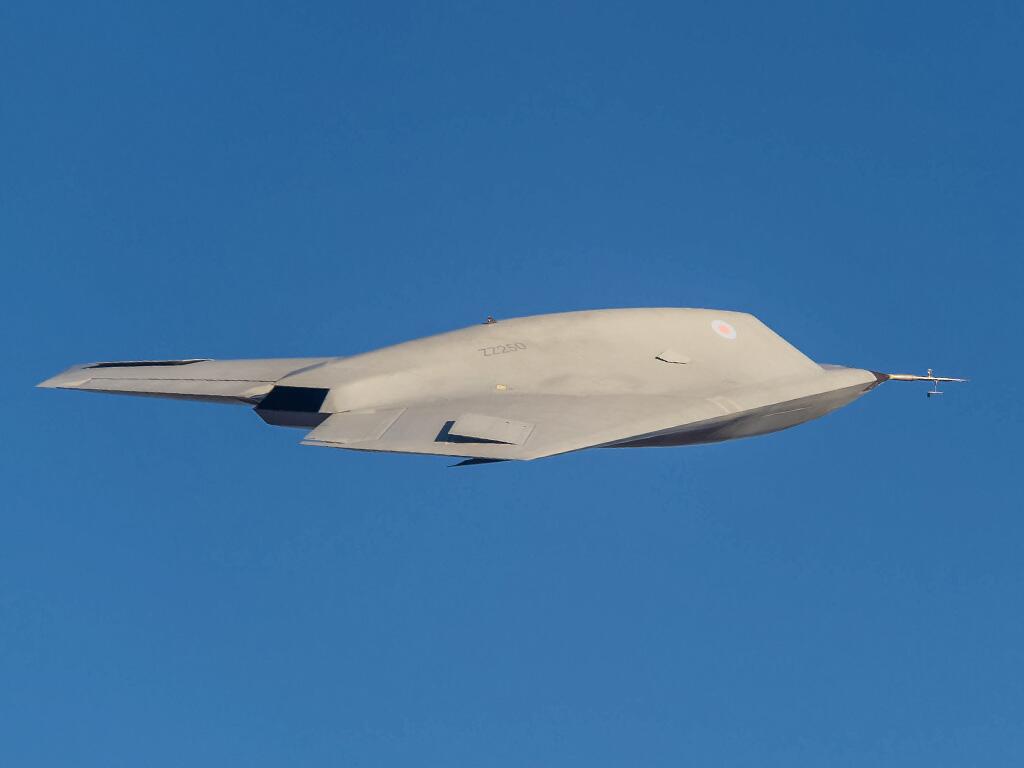
FIRST FLIGHTS OF UK-BUILT TARANIS UNMANNED AIRCRAFT SURPASS ALL EXPECTATIONS

Maiden flight
Taranis, named after the Celtic god of thunder, made its maiden flight at an undisclosed test range on Saturday 10 August 2013, under the command of our test pilot Bob Fraser.  The demonstrator aircraft made a perfect take-off, rotation, ‘climb-out’ and landing on its 15 minute first flight.  A number of flights took place last year, of up to one hour in duration and at a variety of altitudes and speeds.  The details were revealed at a briefing held in London today.
Under the control of a human operator
The Taranis demonstrator is the result of one-and-a-half-million man hours of work by the UK’s leading scientists, aerodynamicists and systems engineers from 250 UK companies.
The aircraft has been designed to demonstrate the UK’s ability to create an unmanned air system which, under the control of a human operator, is capable of undertaking sustained surveillance, marking targets, gathering intelligence, deterring adversaries and carrying out strikes in hostile territory.
Technological advances
The findings from the aircraft’s flight prove that the UK has developed a significant lead in understanding unmanned aircraft which could strike with precision over a long range whilst remaining undetected. The technological advances made through Taranis will also help the UKMOD and Royal Air Force make decisions on the future mix of manned and unmanned fast jet aircraft and how they will operate together in a safe and effective manner for the UK’s defences.
Jointly funded
Costing £185 million and funded jointly by the UK MOD and UK industry, the Taranis demonstrator aircraft was formally unveiled in July 2010 but only a very limited number of scientists and engineers have ever been given full access to the top secret aircraft.
Progress to date
Initial ‘power-up’ or ground testing commenced later in 2010 at our military aircraft factory in Warton, Lancashire followed by a comprehensive and highly detailed programme of pre-first flight milestones including unmanned pilot training, radar cross section measurements, ground station system integration and, in April 2013 taxi trials on the runway at Warton.
The aircraft and its ground station were then shipped from Warton to the test-range before being re-assembled and undergoing systems and diagnostics checks. Taranis then made a number of high speed taxi tests in July before its maiden flight in August 2013.
Major landmark for aviation
Philip Dunne, Minister for Defence Equipment, Support and Technology said:
"Taranis is providing vital insights that will help shape future capabilities for our Armed Forces in coming decades. Its advanced technology is testament to the UKs world leading engineering skills that keep Britain at the cutting edge of defence."
Commenting on behalf of the industry team, Nigel Whitehead, Group Managing Director, BAE Systems added: “The first flight of Taranis represents a major landmark for UK aviation. The demonstrator is the most advanced air system ever conceived, designed and built in the UK. It truly represents an evolution of everything that has come before it. This milestone confirms the UK's leading position as a centre for engineering excellence and innovation.”
Team Taranis
About the size of our Hawk Advanced Jet Trainer aircraft – we have designed and built Taranis working alongside Rolls-Royce, the Systems division of GE Aviation (formerly Smiths Aerospace) and QinetiQ working alongside UK MOD military staff and scientists. In addition to prime contracting the project, we led on many elements of the Taranis technology demonstrator, including the low observability, systems integration, control infrastructure and full autonomy elements (in partnership with QinetiQ).http://www.baesystems.com/

Tuesday, 4 February 2014

Northrop to ‘position’ for future bomber work as LRS-B progresses


Northrop Grumman says it has interest in continuing to provide the US Air Force with bomber aircraft, an indication that the company remains a potential bidder to build the service’s next-generation long-range strike bomber (LRS-B) fleet.

“Clearly we have a strong legacy in the business of providing bombers to the United States Air Force,” Northrop’s chief executive Wesley Bush said during the company’s fourth quarter 2013 earnings call on 30 January. “And I think our shareholders should count on us to do the things that we think are appropriate to continue to position our company for the long term there.”
Bush declined to comment further, and the company did not respond to a request for more information.
But Mark Gunzinger, senior fellow at the Washington, DC-based Center for Strategic and Budgetary Assessments, says the comments hint that Northrop intends to spend money to develop some of the new technology the bomber programme will require.
“I would expect they continue to invest in technologies needed for that kind of a programme and other advanced aircraft programmes, including future unmanned aircraft,” says Gunzinger.
Such technology could include advanced stealth design, new mission management systems and systems that allow aircraft to operate with greater autonomy, he says.
“Those are all key technologies that an aerospace company would invest in to be able to develop a combat aircraft in the future, either manned or unmanned,” Gunzinger adds.
Although Northrop has not officially announced that it will compete for the at least $100 billion programme, the company, which makes the B-2 stealth bomber, is seen as a prime competitor. If it enters the competition, it will compete against a Boeing/Lockheed Martin team. Those two companies initially partnered to build a next-generation bomber in 2008 but cancelled that relationship in 2010.
Boeing, which has built bombers including the B-17, B-29, B-47 and B-52, announced in October 2013 that it had again agreed to work with Lockheed on the LRS-B project.
The USAF declines to provide any updates on the programme's progress, but the project is slated to receive $359 million in funding in the US government’s fiscal year 2014 budget, according to budget documents. The sum is $20 million less than the Department of Defense requested for LRS-B this fiscal year, and the air force adds that progress also depends on funding in FY2015.
The USAF has said it intends to acquire between 80 and 100 LRS-B aircraft and has targeted the mid-2020s as an operational timeframe.
Though details of the programme remain classified, the service has said its acquisition strategy emphasises the use of proven technologies, which would help keep costs down by minimising development of new avionics, engine and airframe technology.http://www.flightglobal.com/

Friday, 31 January 2014

Dassault and BAE Systems welcome Anglo-French UCAV pact

asset image

BAE Systems and Dassault Aviation have welcomed the launch by the UK and France of a joint two-year £120 million ($198 million) feasibility study into a future unmanned combat air vehicle (UCAV).
The pact was unveiled today at a summit between Prime Minister David Cameron and French President Francois Hollande at RAF Brize Norton in the UK.
Early research on the programme has already been carried out by the two companies, along with partners Rolls-Royce, Safran, Thales and Selex, leading to the recent completion of a joint study presented to both governments. The "preparation phase" work was conducted following the 2010 Lancaster House treaty, which deepened defence ties between the two nations.
asset image
Eric Trappier, Dassault chief executive, says: "This launch by the French and British authorities is contributing to the development of the combat air systems sector, and is paving the way for the future in this strategic field."
Ian King, chief executive of BAE Systems, adds: "Given the strong research and development investment and progress in technology that has already been made, continuing work in unmanned air systems will also ensure we maintain the core knowledge and key skills necessary to make a make a long-term contribution to both our national economies.”
Both companies have already been working on UCAV demonstration programmes. BAE's Taranis has conducted test flights in conjunction with the UK Ministry of Defence, while Dassault was the industrial lead on the multination Neuron programme, which made its maiden flight in December 2012.
Technologies from both are likely to be utilised on the future Anglo-French UCAV.http://www.flightglobal.com/

Tuesday, 28 January 2014

Diehl Defence successfully demonstrated IRIS-T SLM ground based air defence system.

Diehl Defence successfully demonstrated its Ground Based Air Defence System IRIS-T SLM in the presence of international experts and military representatives from 16 nations at the Overberg Test Range in South Africa on January 14, 2014.

The IRIS-T SLM Ground Based Air Defence System is characterized by its modular design and open system architecture. In the current campaign, IRIS-T SLM consisted of the new CEAFAR radar of CEA Technologies, Australia, a Tactical Operation Center (TOC) employing both the BMD-Flex command, control and communication system of Terma A/S, Denmark, and the Oerlikon Skymaster battle management system of Rheinmetall Air Defence, Switzerland as well as the IRIS-T SL launching station with Diehl Defence missiles. All elements were integrated into the system by the Diehl Defence Sensor, Fire, and Weapon Control.

IRIS-T SLM detected the low flying target drone of type DO DT-25 and established a stable track which was classified as hostile. The missile was launched at a distance of about 20 km and intercepted the target with a direct hit. During the entire flight, target data updates from the radar were provided to the missile through the data link allowing the infrared seeker to lock onto the target in flight for the endgame. All hardware and software components performed flawlessly.

Diehl Defence successfully demonstrated its Ground Based Air Defence System IRIS-T SLM in the presence of international experts and military representatives from 16 nations at the Overberg Test Range in South Africa on January 14, 2014.

For the first time, Diehl Defence demonstrated the full functionality of the IRIS-T SLM system comprising its own setup for radar, TOC and launcher in a real live firing. This event followed two successful test firings carried out last November, during which the IRIS-T SL launcher and missile were tested as part of the German development contract of Diehl Defence with the German Federal Office of Bundeswehr Equipment, Information Technology and In-Service Support (BAAIN Bw).

The IRIS-T SLM demonstration firing was supported by the German Ministry of Defence and the Australian Department of Defence. Close to 90 visitors from around the world witnessed the live firing demonstration inside the test range control center and were informed in detail about the operational capabilities and the technical details of the Ground Based Air Defence system during the test campaign.http://www.armyrecognition.com/

Saturday, 25 January 2014

Meet the SR-72

SR-72
In 1976, U.S. Air Force SR-71 Blackbird crews flew from New York to London in less than two hours, reaching speeds exceeding Mach 3 and setting world records that have held up for nearly four decades.
But those world records may not stay unbroken for long.

That’s because today, at the birthplace of the Blackbird – Lockheed Martin’s Skunk Works® – engineers are developing a hypersonic aircraft that will go twice the speed of the SR-71. It’s called the SR-72. 

Son of the Blackbird

The SR-71 was developed using 20th century technology. It was envisioned with slide rules and paper. It wasn’t managed by millions of lines of software code. And it wasn’t powered by computer chips.  All that changes with the SR-72.

Envisioned as an unmanned aircraft, the SR-72 would fly at speeds up to Mach 6, or six times the speed of sound. At this speed, the aircraft would be so fast, an adversary would have no time to react or hide.

“Hypersonic aircraft, coupled with hypersonic missiles, could penetrate denied airspace and strike at nearly any location across a continent in less than an hour,” said Brad Leland, Lockheed Martin program manager, Hypersonics. “Speed is the next aviation advancement to counter emerging threats in the next several decades. The technology would be a game-changer in theater, similar to how stealth is changing the battlespace today.”

A hypersonic plane does not have to be an expensive, distant possibility.  In fact, an SR-72 could be operational by 2030. For the past several years, Lockheed Martin Skunk Works® has been working with Aerojet Rocketdyne to develop a method to integrate an off-the-shelf turbine with a supersonic combustion ramjet air breathing jet engine to power the aircraft from standstill to Mach 6. The result is the SR-72 that Aviation Week has dubbed “son of Blackbird,” and integrated engine and airframe that is optimized at the system level for high performance and affordability.

SR-72-chart
Hypersonic Research and Development
SR-72 is not the first hypersonic Skunk Works® aircraft. In partnership with the Defense Advanced Research Projects Agency, engineers developed the rocket-launched Falcon Hypersonic Technology Vehicle 2 (HTV-2). The HTV-2 research and development project was designed to collect data on three technical challenges of hypersonic flight: aerodynamics; aerothermal effects; and guidance, navigation and control.
The SR-72’s design incorporates lessons learned from the HTV-2, which flew to a top speed of Mach 20, or 13,000 mph, with a surface temperature of 3500°F.
A hypersonic aircraft will be a game changer.http://www.lockheedmartin.com/

TAI eyes overseas buyers for domestic training planes


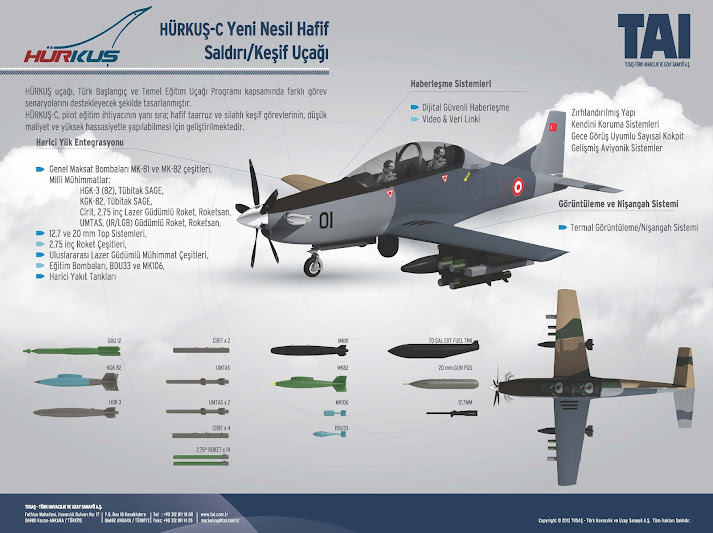
Turkish Aerospace Industries (TAI) is focused on finding buyers for its indigenously manufactured local training plane Hürkuş overseas, the head of the company’s plane unit said, adding there were already two companies interested in buying the plane made in Turkey.

“Our biggest objective in 2014 is marketing the Hürkuş,” TAI Plane Group Head Özcan Ertem said yesterday, speaking to Anadolu Agency.

Turkish defense manufacturer TAI had inked a deal with Undersecretariat for Defense Industries (SSM) for the serial production of the domestic basic trainer aircraft on Dec. 26 that involves the production of 15 Hürkuş-Bs, an advanced version with advanced avionics for the Turkish army.

TAI also said the contract involved conceptual design work for the Hürkuş-C, an armed aircraft with aerial support, reconnaissance and surveillance roles. 

Ertem said there were two countries “seriously interested in” the Hürkuş, adding the serial order won by the Turkish Army and the SSM paved the way for marketing efforts for foreign markets.

“Other countries look skeptically at a plane that your own country doesn’t use,” he explained, noting the Turkish Army “is known to be demanding strong and ambitious systems,” which added to the value of the program.


The Hürkuş will be equipped for day and night flying, as well as for basic pilot training, instrument flying, navigation training, and weapons and formation training. It will have good visibility from both cockpits, with a 50-degree down-view angle from the rear cockpit, ejection seats, an on-board oxygen generation system, an environmental control system, an anti-G system, and shock-absorbing landing gear for training missions.


On Dec. 23, Turkish military electronics specialist Aselsan signed a $167.4 million contract with the Turkish government to build an X-band satellite communications system.Source:Anadolu Agency

Friday, 24 January 2014

Forced by Budget Cuts, US Army is Likely to End GCV Program


The Ground Combat Vehicle variant developed by BAE Systems would have used a new hybrid-electric propulsion system that would rely on a diesel engine running a generator and electrical drive motors to power the vehicle and feed its many electronic systems. Photo: BAE Systems
If the US omnibus budget bill that President Obama signed earlier this month didn’t already make it clear, the Army’s Ground Combat Vehicle program is all but dead. Paul McLeary reported on Defense News today, quoting U.S. Army Chief of Staff of the General Raymond T. Odierno talking on a breakfast speech earlier today. A week after Congress slashed $492 million of the program’s funding for 2014, leaving merely $100 million that will suffice to keep some technology development, Odierno has made it clear where this program stands: “Do we need a new infantry fighting vehicle? Yes. Can we afford a new infantry fighting vehicle now? No.” Odierno stated.
Odierno said he hopes that the remaining funding will allow the Army to continue to develop technology so that “three to four years from now” the service can get back to building a new infantry fighting vehicle to replace the aging Bradley.
Parallel development has been underway at BAE Systems and General Dynamics since 2011. However, the program came under pressure, as the costs of buying the 1,748 vehicles at about $17 million a piece, and sustaining them in service would cost the Pentagon $29 billion in the next 16 years.
Not less concerning was the vehicle’s growing weight. At a combat weight comparable to an M-1 tank, the GCVcould not be rapidly transported by air, and would be too heavy for the type of small intervention missions the Pentagon foresees for the near future. The funding cut essentially killed the GCV acquisition program, as there isn’t enough money for the Army to move forward by awarding a production contract to one of the two companies. The move could affect BAE systems, which has already announced it will close one of its armored vehicles manufacturing lines at Sealy TX in June 2014. The company still operates the second line in York, PA. where BAE is hopeful to remanufacture Bradley armored vehicles into AMPVs. Nevertheless, the prospects are likely for part of the GCV remaining funds spent on BAE Systems’ hybrid electric propulsion, given its potential to introduce new capabilities that would be relevant for the Army for years to come.
The news are even more alarming to General Dynamics Land Systems (GDLS) operating the Joint Systems Manufacturing Center, also known as the Lima Army Tank Plant (LATP) in Ohio, where the modernization and remanufacturing of M-1 tanks continues at a slow pace through 2015. The future here isn’t bright, with the planned cut in production of Namer armored vehicles, and uncertainty of continued supplies of M-1A1 kits to Egypt. The hope to get substantial orders for GCV after 2017 would provide some incentive to retain part of the workforce at Lima.
“We have to be expeditionary” Odierno said, “We have to be prepared to deploy very quickly. We have to get there in small packages. We have to get there with the least amount of support necessary. We have to be able to go to remote areas.” “We’re going to build new when its absolutely essential,” Odierno said, calling out the Joint Light Tactical Vehicle (JLTV) and Armored Multi-Purpose Vehicle (AMPV) as programs that will live on. “We have to have these systems” to replace the ancient M113 infantry carrier and the Humvee.  by www.defence-talk.com