Showing posts with label Turkey. Show all posts

Saturday, 7 May 2016

Turkey Setting Sails on Big Naval Ambitions


ANKARA, Turkey — Turkey has just officially begun constructing its first landing platform dock (LPD) but the country’s president already is talking about future production of an aircraft carrier and even a nuclear vessel.
The production of the TCG Anadolu, Turkey’s first amphibious assault ship, kicked off last month at a high-profile ceremony attended by defense and procurement VIPs and President Recep Tayyip Erdogan.
Speaking at the ceremony, Erdogan praised efforts for Turkey’s all indigenous development programs, including the LPD, although he called the ship’s production “a belated move.”
He said that Turkey’s dependence on foreign arms systems has dropped from 80 percent in 2002 — when his government came to power — to 40 percent. “We must aim at zero dependency by the year 2023,” he said.
Erdogan said that the LPD program would hopefully be the first step toward producing a “most elite” aircraft carrier. Then he upped Turkey’s naval ambitions.
“I see it as a major deficiency that we still do not have a nuclear vessel,” he said.
But officials and experts are cautious.
“I am not sure if we can afford such ventures in the short-run,” said one procurement official. “I am not sure, either, if such grand designs would fit our security threat perceptions.”
A London-based Turkey specialist said: “The idea [about a carrier and a nuclear vessel] goes in line with Turkey’s political ambitions. All the same, I’d say, it is as much over-ambitious as Turkey’s political designs.”
In 2013, Turkey announced that it had selected the local shipyard Sedef for its LPD program. In the LPD contract, Sedef is partnered with Spain's Navantia.
The planned amphibious assault vessel will carry a battalion-sized unit of 1,200 troops and personnel, eight utility helicopters and three unmanned aerial vehicles; it also will transport 150 vehicles, including battle tanks.
It also may have an aircraft platform for vertical takeoff and landing. A ski jump at the front of the deck can be used to launch fighter aircraft.
Metin Kalkavan, chairman of Sedef, told reporters that it was not clear at this stage whether the TCG Anadolu would feature a ski jump. “We’ll decide on that at later stages of the program,” he said.
Industry sources estimate the cost of the contract at over $1 billion.
Under the original production plan the 231-meter-long vessel will be completed within 5½ years. But Erdogan urged Sedef to deliver the vessel within four years.
“That way,” Erdogan said during the ceremony, “you can win further contracts from foreign customers as well as from our government.”
The TCG Anadolu will be deployed on the Aegean Sea, Black Sea and the Mediterranean Sea, as well as on Turkish Navy's operations in the Atlantic and Indian oceans.
Turkey will be the third operator in the world of this ship type after Spain and Australia.
Last year, two Turkish defense firms won more than €200 million (US $343 million) worth of subcontracts in the LPD program
The companies, Aselsan and Havelsan, both state-controlled, announced that the contracts they signed with Sedef involve warfare and electronic systems and their integration.
Military electronics specialist Aselsan, Turkey's biggest defense company, signed a deal for €127 million. Its work includes communications, satellite and IFF systems, 12.7mm STAMP and 25mm STOP guns, acoustics, sonars, radars, electronic warfare systems, infrared tracking systems, laser warning systems, and cruise systems.
Havelsan's work, worth €87 million, includes a network-supported warfare management system (ADVENT), ship data distribution, a CCTV system, the Link 11/16/22 tactical communications system, an amphibious mission force command center, a landing force command center, and a command, control and information system.
A naval industry official said that programs like LPD would significantly benefit the local industry in earning them capabilities which they did not possess before.
“It is not just the amount of money that will flow into local companies. More importantly it will be the technological capabilities they will learn to produce and improve in further contracts of this type,” he said. http://www.defensenews.com/

Friday, 28 February 2014

US behind Turkey's purchase of Chinese missile system: Kanwa


The primary reason for Turkey, a major US ally and a member of the North Atlantic Treaty Organization, to purchase the FN FS-2000, the export version of the Chinese HQ-9 long-range surface-to-air missile, was not to defend its airspace but to steal critical information regarding the missile for the United States, according to Kanwa Defense Review operated by Andrei Chang, a military analyst based in Canada, also known as Pinkov.
Turkey's national interests rely on the acceptance of the United States and European Union, the article said that and for this reason it is very hard to imagine that some day Turkey will side with potential NATO adversaries such as Russia or China. The government in Ankara also realizes how much pressure will be on them if they chose to purchase Chinese instead of American air defense systems.
Kanwa said that Turkey's new cross-harbor tunnel beneath the Bosphorus was completed with investment from Japan. As Japan is now a major advocate of Turkey's accession to the European Union, the report said it is impossible for it to become a security partner with China, which is engaged in a territorial dispute with Japan in the East China Sea.
The report also said that Germany, a fellow NATO member, could can stop Turkey from getting too close to China through halting the provision of supplies that the Turkish navy requires for its Meko-class frigates. The United States can also refuse to sell the fifth-generation Lockheed Martin F-35 stealth fighters to Turkey in protest against Ankara's cooperation with Beijing. This would be a very expensive price for Turkey to pay for changing sides, according to the magazine.
As most of its weapons systems are from either the United States or other NATO powers, Turkey is unlikely to purchase Chinese missiles, Kanwa said, which is why Russia pulled its S-400 from the competition. Apparently, Turkey is trying to steal critical data from the HQ-9 for its allies through the purchase of the Chinese missile, following the example of South Korea when it previously did the same with the Russian-built Sukhoi Su-35 fighter.http://www.wantchinatimes.com/

Saturday, 22 February 2014

Azerbaijan and Roketsan of Turkey to produce jointly 107mm and 122mm artillery rockets.

Azerbaijan’s Ministry of Defense Industry and ROKETSAN company of Turkey will sign a final document on the joint production of missiles at an Azerbaijani facility, said Turkey's Undersecretariat for Defense Industries (SSM).

Azerbaijan’s Ministry of Defense Industry and ROKETSAN company of Turkey will sign a final document on the joint production of missiles at an Azerbaijani facility, said Turkey's Undersecretariat for Defense Industries (SSM).

Technical issues on joint production have already been solved. Necessary measures are being taken to start the production. SSM has not revealed when the final document will be signed.

According to the agreement, 107 and 122 mm caliber missiles will be manufactured at the Azerbaijani facility with the participation of ROKETSAN. The engines for these missiles will be produced by ROKETSAN, other parts in Azerbaijan.

The development studies of 107mm and 122mm artillery rocket systems started in the early 1990's, after a cooperation aggrement between MKEK and TUBITAK - SAGE was signed under the supervision of MSB (Milli Savunma Bakanligi; Ministry of National Defence) and SSM. According to the cooperation framework, SAGE was to conduct research and development studies on short and medium range artillery rockets and MKEK was to undertake the production process, using double base propellant technology gained by the licensed production of M72 LAW (Light Anti-Tank Weapon) started in late 1970's. 

The results were 107mm Anadolu rocket with a 8km of range and 122mm Mizrak (Spear) rocket with 20km of range produced in MKEK - ELROKSAN division (Elmadag Roket Sanayii; Elmadag Rocket Industries).
http://www.armyrecognition.com/

Friday, 21 February 2014

Turkey, Sikorsky Sign $3.5 Billion Helicopter Deal


Turkish Prime Minister Recep Tayyip Erdogan announced Friday that his government and US helicopter manufacturer Sikorsky Aircraft had signed a long-dormant contract to co-produce an initial batch of 109 utility helicopters.

“We signed the $3.5 billion agreement today,” Erdogan said in televised remarks during a ceremony for the delivery by Boeing of Turkey’s first airborne early warning and control aircraft. “This [Sikorsky deal] was an important signing ceremony for us.”

In May, Turkey’s procurement office made an unusual announcement: Turkey “had come very close to signing a $3.5 billion contract with Sikorsky Aircraft for the co-production of scores of utility helicopters.” But penning the deal had since been delayed as top Turkish procurement management accused “US corporate and other bureaucracy” for factors that caused delays.

Turkey in 2011 selected Sikorsky as its partner company to lead production of the country’s next-generation utility helicopters. Sikorsky defeated Italian-British AgustaWestland by bidding its T-70, the Turkish version of its S-70 Black Hawk International.

The S-70 Black Hawk International is used by dozens of militaries, including Turkey. AgustaWestland was competing with its TUHP 149, the Turkish version of its newly developed A-149.

The first batch will be for 109 utility helicopters, but with follow-on orders, more than 600 platforms could be built at a cost of more than $20 billion, defense analysts said.

Most helicopters in the first batch will go to the military, with the Gendarmerie receiving the largest portion, and the Army, Navy, Air Force and the special forces command each getting their share. The remaining machines will go to the Security Directorate, meaning the police forces, and to the Firefighting Department. ■http://www.defensenews.com/

Wednesday, 19 February 2014

Turkey gears up efforts for indigenous rotor production


Turkey’s ATAK, T-129 attack helicopter, co-produced by Italy’s AgustaWestland and Turkish Aerospace Industries (TAI) is seen in this file photo. TAI is also tasked with producing a local helicopter.

Another sign has emerged that Turkey’s defense industry planners are serious about their ambition to manufacture an indigenous helicopter locally, with Ankararecently launching efforts to build the capability to produce a Turkish rotor. 

Turkey’s civilian defense procurement agency, the Undersecretariat for Defense Industries (SSM), has said a “Rotor Technology Center” has been launched. The move comes as part of a June 2013 contract that the SSM signed with the country’s aerospace powerhouse, the Turkish Aerospace Industries (TAI).

The SSM said the rotor technology center, or DKTM according to its Turkish acronym, would aim to build rotor technologies through research and development activity and to train the scientifically competent personnel Turkey’s defense industry would need in the future, especially in view of a program to design, develop and manufacture the country’s first indigenous helicopter.  

The DKTM is planning to organize a workshop on March 14 for discussions on its own working principles and projects as part of the rotor production program.  

Last summer, Turkish procurement authorities formalized their plans to build a Turkish helicopter when they tasked TAI with the job.  

The program was launched in June 2010, and TAI submitted its bid to be the local prime contractor in October 2012. TAI’s five-ton, twin-engine “light” helicopter will meet the Turkish military requirements in the medium- and long-run, but will also have a civilian model for the commercial market. 

Sikorsky cooperation

The Turkish helicopter aims to replace Turkey’s aging UH-1s, but it could also be used to meet Army helicopter training needs.  

Officials have said Turkey intends to use know-how and technology transfers it would earn from a Sikorsky-led utility helicopter program. 

In May 2013, Turkey’s procurement officials said they came close to signing a $3.5 billion contract with Sikorsky Aircraft for the co-production of scores of utility helicopters, but a contract has yet to be announced. 


TUHP 149, the Turkish version of its newly developed AW149. 

Turkey in 2011 selected Sikorsky as its partner company to lead production of the country’s next-generation utility helicopters. Sikorsky’s T-70, the Turkish version of the company’s S-70 Black Hawk International, defeated Italian-British AgustaWestland for the contract. The S-70 Black Hawk International is used by the militaries of dozens of countries, including Turkey. AgustaWestland was competing with its TUHP 149, the Turkish version of its newly developed AW149. 

The first batch will be for 109 utility helicopters, but with follow-on orders, more than 600 machines could be built at a cost of more than $20 billion, according to defense analysts. 

Sikorsky and AgustaWestland had announced benefit packages worth billions of dollars each. Several Turkish companies, most notably TAI, will take part in the joint production.http://www.hurriyetdailynews.com/

Azerbaijan in talks with Turkey to purchase FNSS Samur AAAB Armored Amphibious Assault Bridge


Azerbaijan and Turkey are holding talks on Samur (AAAB Armored Amphibious Assault Bridge) mobile offensive floating bridges produced by Turkish FNSS Company. Head of the International Cooperation Department of the Under-Secretariat for Turkish Defense Industry, Yakup Tashdelen said; "negotiations are already underway to sell Azerbaijan the mentioned system."
"This bridge system is used today by the Turkish army. Azerbaijan's army has expressed interest in purchasing this system," Tashdelen noted.

The AAAB System is a bridge and ferry system designed for Turkish Armed Forces' fast and safe transport through the rivers in the battlefield. The vehicle is designed and manufactured by the Turkish Company FNSS. As nationally designed and developed amphibious bridge system in Turkey, the AAAB system has some additional specifications among its kind. It can carry 4 ramps on a single system. 

He also said Turkey is interested to sell various systems to Azerbaijan in the sphere of defense and other related industries.


"Turkey offered Azerbaijan a number of security systems, armored vehicles from Otokar and missile systems Roketsan," he noted. "Negotiations are being conducted over the issue of Azerbaijan's assignment of Information System of tactical defense Selsan in the future which enables maintaining video connections between different levels. Furthermore, Azerbaijan is interested in national Atak helicopters from the Tai company, testing of which was recently completed."

Azerbaijan is strengthening its military power and defense capabilities year by year. The establishment of the Ministry of Defense Industry has been instrumental in strengthening the defense capabilities of the country.

The defense products output in Azerbaijan surged by more than eight-fold during 2005-2013. The country's defense industry ministry has started the mass production of a variety of munitions in recent years.

http://www.armyrecognition.com/

Turkey Demands $183M in Penalties From Boeing for AEW&C Program Delays


The Turkish government has demanded $183 million worth of penalties from Boeing due to major delays in the delivery of spy planes to the NATO ally, officials said Feb. 18.

A senior procurement official familiar with Turkey’s airborne early warning and control (AEW&C) aircraft program said that Ankara demanded Boeing pay the penalty in services.

Cemal Evci, project coordinator at the Undersecretariat for Defense Industries (SSM), told reporters that the Turkish Defense Ministry demanded an increase in the start-up support period from an initial two years to five years as well as three years of software maintenance service in addition to $32 million worth of spare parts in return for writing off the $183 million penalty and accumulated interest due to delays in the AEW&C program.

Boeing officials were not immediately available for comment.Boeing delivered the first aircraft to Turkey in late January although original deliveries had been planned for 2008 under the approximately $1.3 billion contract for four aircraft.

Boeing has said that it will complete deliveries in 2015. The company said two more AEW&C aircraft are to be delivered this year, with the fourth in 2015. In addition to the aircraft, the program, dubbed “Peace Eagle,” includes ground support segments for mission crew training, mission support and system maintenance.

The AEW&C is based on the Boeing 737-700 airplane, a popular commercial jet. Australia and South Korea also operate the AEW&C platforms.

Turkish defense officials say Turkey had paid Boeing $637 million in advance. ■http://www.defensenews.com/

Friday, 14 February 2014

Tunisia has ordered to Turkey local-made Kirpi MRAP mine protected vehicle produced by BMC.


According to the Dunya Turkish newspaper, the Turkish defense minister Ismet Yilmaz has announced the purchase by Tunisia of Turkish-made MRAP "Kirpi". He also said that the Turkish Company BMC will restart the production of the Kirpi. BMC was declared bankrupt and confiscated by TMSF (Savings Deposit Insurance Fund of Turkey) in May 2013 after its parent company Cukurova Holding failed to meet certain financial obligations.

BMC is the manufacturer of the Kirpi, a mine-resistant, ambush-protected (MRAP) vehicle. The Kirpi is the country’s first locally designed and developed MRAP.

Last year, the Turkish Armed Forces terminated a contract with BMC for the acquisition of 468 Kirpi. Under a 2009 contract with the Turkish government, BMC produced and delivered an initial 293 Kirpi but failed to comply with the original delivery schedule.

The National Defense Ministry of Turkey had signed a deal in 2009 with BMC to produce 468 Kirpi and trucks in a range of sizes, to be delivered by the end of 2012. BMC has agreed to sell 468 Kirpi, armored vehicles, to Turkish defense ministry, but due to its financial problems the production is still 175 Kirpi behind. 

The BMC Kirpi was presented for the first time to the public during the Defense Exhibition in France, Euroastory in 2010. 

The Kirpi of Turkish army is equipped with one small open roof cupola with foldable protective walls armed with a 7.62 mm machine gun. 

The hull of the Kirpi is made in steel armor, which give a protection up to Stanag 4569 Level 3. The bottom part is protected against grenades and land mines up to Stanag 4569 Level 3b. The Kirpi is a vehicle from the MRAP (Mine Protected Armoured vehicle) category.http://www.armyrecognition.com/

Thursday, 6 February 2014

Turkey Government Puts Vehicle Maker BMC up for Sale

ANKARA — A fund administered by the Turkish government has put the troubled armored vehicles maker BMC up for sale.


BMC was seized in May due to financial obligations its parent company, Cukurova Holding, failed to fulfill. The group’s debts amounted to $455 million.

In July, Defense News reported that BMC would be put up for sale

The Saving Deposit Insurance Fund said on Tuesday it set an estimated price of $434 million for the firm that will be sold through a closed envelope auction.

BMC is the maker of the Kirpi, the mine-resistant, ambush-protected (MRAP) vehicle. The Kirpi is the country’s first locally designed and developed MRAP.

Last year, the Turkish Armed Forces terminated a contract with BMC for the acquisition of 468 Kirpis. Under a 2009 contract with the Turkish government, BMC produced and delivered an initial 293 Kirpis but failed to comply with the original delivery schedule.

Procurement officials say that in addition to the 175 Kirpis for the Army, the police force could order 20 more. Follow-on orders from the Army and the police are also likely, they say.
The Kirpi can accommodate 13 personnel and can move over any terrain at a maximum speed of 105 kilometers per hour.

In 2011, BMC was in talks to sell scores of Kirpis to Iraq and Afghanistan. Industry sources said they see significant demand for the Kirpi in countries exposed to mine and ballistic attack threats.

Industry sources predict substantial foreign demand for the Kirpi, including in some Asian and African countries. BMC was planning to launch a special production line for a right-hand drive version of the Kirpi, which would help in the marketing to some Asian countries, including Bangladesh, Indonesia, Pakistan, Malaysia, Sri Lanka and Thailand.■http://www.defensenews.com/

Tuesday, 4 February 2014

Aselsan ‘suffers’ from Chinese missile accord

Turkish defense firm ASELSAN is trying to cope with the problems stemming from a missile deal with China. Thirty experts that came from China held talks at ASELSAN amid the pressure from the West

While the diplomatic tremors Turkey has created by awarding a long-range missile tender to a company from China continue, problems for ASELSAN – which will also take part in the project – are compounding.

Officials from the Chinese firm CPMIEC came to the Military Electronic Industries of Turkey (ASELSAN) to build up a partnership last week, but Turkish officials are still keeping the door open for Western firms that lost in the missile tender last year to perhaps swoop in and clinch the ultimate agreement.

The 30 experts that came from China held talks at ASELSAN, mostly working on matters related to research and development. In their bid, the Chinese firm stated that a portion of the project would be carried out in cooperation with ASELSAN. 

However, this situation and the visit created turmoil, rather than pleasure, at ASELSAN, amid the knowledge that Western military powers have consistently said CPMIEC’s missile defense system cannot be integrated into a NATO-wide network. CPMIEC is also under Western sanctions for violating non-proliferation acts with countries such as Syria, Iran and North Korea.

As business proceeds, the anxiety of the ASELSAN management has increased, and there are suggestions that “such a decision on cooperation cannot be made at the executive committee but can only be made at the General Assembly.”

The ASELSAN management made an inner study following reaction from the West, noting the effect that partnerships with Western firms could be severed due to the continued cooperation with CPMIEC.

ASELSAN, which is known to be the cradle of technological development in Turkey, will experience extensive damage in the event that the cooperation with CPMIEC continues, according to sources. Also, ASELSAN’s development both economically and technologically could be interrupted. 

The ASELSAN management, which is anxious because of the Chinese visitors, is also re-contacting the French-Italian partnership and the American companies which lost the September 2013 tender
. 
One source said the discussions could not have happened without the permission of the government. “The government probably understood it made a mistake after some consultations and is looking for ‘ways to reverse the decision.’” 

According to a story broadcast on CNNTürk last week, French President Françis Hollande and a French defense delegation met with Defense Minister İsmet Yılmaz and defense industry undersecretary Murad Bayar in Ankara during which a renewal of the French partnership’s offer was discussed. After this, U.S. Ambassador in Ankara Ambassador Francis Riccardone met with Bayar regarding the situation of the American firm.


No foreigners to broker public offerings

Meanwhile, ASELSAN has also been experiencing trouble in terms of public offerings due to the selection of CPMIEC. Merrill Lynch initially said it did not want to broker a public offering because of the American administration’s stance. Barclays won the tender, followed by Merrill Lynch and Goldman Sachs. Because the first bid was too expensive for ASELSAN, the management submitted an offer to the firm in second place, Merrill Lynch. After the U.S. company refused to deal with ASELSAN over fears of sanctions, the Turkish defense firm spoke to Barclays and Goldman Sachs again. Both firms subsequently expressed concerns similar to Merrill Lynch’s, demanding assurances that “no work will be done in cooperation with the Chinese firm.” 

After negotiations with all three companies fell through, ASELSAN’s management also contacted, albeit unofficially, foreign establishments such as Citibank and Credit Suisse, but received the same reply.
Consequently, it appears as if ASELSAN’s second public offering, which has been planned for a long time, has been postponed. 

ASELSAN is reportedly now trying to find a Turkish stock broker to broker the public offering.
http://www.hurriyetdailynews.com/

Friday, 31 January 2014

First Turkish "Peace Eagle" AWACS Ready to Service


In the requirement of Turkish Air Forces (TAF), first AWACS aircraft within the “Peace Eagle” programme being carried out by Undersecretariat for Defence Industries (SSM), for initial delivery, take off from TAI facilities to Konya which 3rd Main Jet Base Commands to be deployed on.

“Peace Eagle” AWACS Aircraft will be service into the inventory of Turkish Air Forces at 21 February 2014 at 3rd Main Jet Base Commands (Konya) after the unit acceptance test will be approved. ,Within the scope of Peace Eagle Programme, total 4 aircraft will be deliveried to Turkish Air Forces http://www.defence-turkey.com/

Thursday, 30 January 2014

Turkey Extends Deadline for US, European Missile Bidders


ANKARA — US and European bidders still interested in winning Turkey’s air defense contract now have until April 30 to submit their proposals, following a three-month extension instituted by Turkey.

The bidders originally had until the end of this month to submit bids for Turkey’s first air and missile defense system, for which it initially selected a Chinese manufacturer.

The bidders comprise a partnership of Raytheon and Lockheed Martin, makers of the Patriot Advanced Capability-3 system, and the European group Eurosam, maker of the Aster 30 missile.

In September, Turkey said it selected China Precision Machinery Import-Export Corp. (CPMIEC) to build the country’s first long-range air and anti-missile defense system. CPMIEC’s bid was priced at $3.44 billion, according to Muray Bayar, Turkey’s top procurement official.


Turkey has been in contract negotiations with CPMIEC but, under increasing pressure from its NATO allies, it also has urged rival US and European bidders to improve their offers.

“The extension is an indication that we encourage improved rival offers,” said one senior procurement official. “We are in talks with the Chinese manufacturer, but that does not mean we have finalized a deal.”


Meanwhile, French Defense Minister Jean-Yves Le Drian, who accompanied French President François Hollande during his state visit to Turkey on Jan. 27, met with Bayar to discuss the competition.

Turkey said in September that Eurosam’s offer ranked second while the US solution came third. The fourth bidder, the Russian maker of the S-300/400, was eliminated from the contest. 
By BURAK EGE BEKDIL http://www.defensenews.com/

Saturday, 25 January 2014

TAI eyes overseas buyers for domestic training planes


Turkish Aerospace Industries (TAI) is focused on finding buyers for its indigenously manufactured local training plane Hürkuş overseas, the head of the company’s plane unit said, adding there were already two companies interested in buying the plane made in Turkey.

“Our biggest objective in 2014 is marketing the Hürkuş,” TAI Plane Group Head Özcan Ertem said yesterday, speaking to Anadolu Agency.

Turkish defense manufacturer TAI had inked a deal with Undersecretariat for Defense Industries (SSM) for the serial production of the domestic basic trainer aircraft on Dec. 26 that involves the production of 15 Hürkuş-Bs, an advanced version with advanced avionics for the Turkish army.

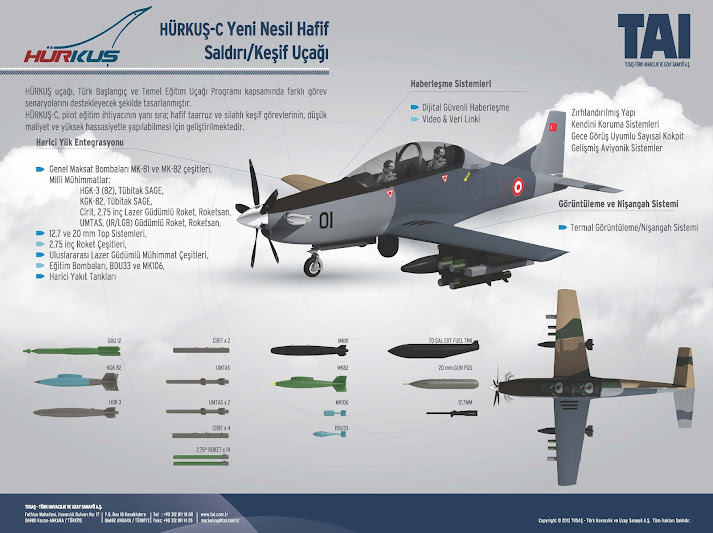
TAI also said the contract involved conceptual design work for the Hürkuş-C, an armed aircraft with aerial support, reconnaissance and surveillance roles. 

Ertem said there were two countries “seriously interested in” the Hürkuş, adding the serial order won by the Turkish Army and the SSM paved the way for marketing efforts for foreign markets.

“Other countries look skeptically at a plane that your own country doesn’t use,” he explained, noting the Turkish Army “is known to be demanding strong and ambitious systems,” which added to the value of the program.


The Hürkuş will be equipped for day and night flying, as well as for basic pilot training, instrument flying, navigation training, and weapons and formation training. It will have good visibility from both cockpits, with a 50-degree down-view angle from the rear cockpit, ejection seats, an on-board oxygen generation system, an environmental control system, an anti-G system, and shock-absorbing landing gear for training missions.


On Dec. 23, Turkish military electronics specialist Aselsan signed a $167.4 million contract with the Turkish government to build an X-band satellite communications system.Source:Anadolu Agency

Tuesday, 21 January 2014

For Turkey, Precision Is Maximum Lethality, Minimum Cost

Multiplatform: The UMTAS is primarily a weapon of the Turkish T-129 helo and the Anka UAV, but potentially for armored land vehicles and naval vessels.
Multiplatform: The UMTAS is primarily a weapon of the Turkish T-129 helo and the Anka UAV, but potentially for armored land vehicles and naval vessels. (Roketsan)

ANKARA — Turkish interest in precision strike has increased sharply in recent years with local industry steadily becoming more active in providing those capabilities.“Countries like Turkey facing multiple conventional and asymmetrical threats at the same time in a relatively large and unstable geography must economize militarily and financially unless they spend tens of billions in armament,” one senior officer at the Turkish military’s doctrine unit said. “And Turkey is not one of those spending-rich countries.”

This underscores a pressing need for smart, precision strike, a procurement official said.


“Like most other militaries with regional or global defense ambitions, Turkey’s is targeting maximum lethality with minimum costs, given our budgetary constraints. In fact, there is a policy directive to boost programs aiming at maximum lethality with minimal costs,” the official said.


Turkey traditionally spends $3 billion to $4 billion annually for new equipment and modernization programs.


According to a London-based Turkey specialist, the Turks were hardly aware of the merits of precision strike until a few years ago. “The concept itself was luxury thinking for the Turks,” he said. “But with the newfound confidence in their local industry they are now investing impressively in new technologies, which they hope would earn them smart capabilities for better and cheaper hit.”


In February, Turkey’s state-run missile maker, Roketsan, said it won a $196.2 million contract from the United Arab Emirates for its Cirit laser-guided rocket system. Cirit is one of several programs launched by Turkey to equip the Army’s T-129, AH-1P Cobra and AH-1W Super Cobra attack helicopters with low-cost precision strike capabilities. The 70mm rocket has a range of eight kilometers.


Airbus Helicopters, formerly Eurocopter, selected the Cirit for a test and integration program to equip the company’s EC635. Roketsan is also producing canisters for Lockheed Martin’s Patriot Advanced Capability-3 missile.


Roketsan also has developed an anti-tank missile, the UMTAS, whose first deliveries Turkey’s procurement bureaucracy awaits. The missile has had several successful field tests.

The UMTAS, with its infrared imaging and laser-seeker options, is an anti-tank missile with a range of eight kilometers that can be used in air-to-ground and ground-to-ground operations. Roketsan officials said the system is going through further technical tests and tests for compatibility with environmental conditions.


The UMTAS is considered the official anti-tank system for the T-129 and the Anka, Turkey’s first locally developed unmanned aircraft. Armored land vehicles and naval vessels are other potential UMTAS platforms.


Roketsan also has been tasked with producing and marketing the SOM cruise missile, a high-precision missile that can be launched from land, sea and air platforms. The SOM has been developed since 2006 by TÜBÍTAK-Sage, a defense research and development institute. Revealed in 2011, the SOM is Turkey’s first domestic weapon to attack stationary and moving targets at a standoff distance of more than 180 kilometers.


Another program is the HGK guidance kit, also developed by TÜBÍTAK-Sage. The HGK is a GPS/INS guidance kit with flap-out wings that converts 2,000-pound Mark 84 bombs into smart weapons. It enables precision strike in all weather conditions with long range at a dispersion of six meters.

Other major TÜBÍTAK-Sage innovations include the NEB bunker buster, a bomb able to destroy buried targets by penetrating protective reinforced concrete and detonating at a desired time (it is compatible with the HGK); and the KGK guidance kit, a precision guidance wing kit that converts 1,000-pound Mark 83 bombs and 500-pound Mark 82 bombs into long-range fire-and-forget smart weapons.


Turkey’s local industry also is quickly progressing toward serial production of the Atmaca, a radar-guided anti-ship cruise missile; and torpedoes, according to industry sources. But the military official said that such smart weaponry would be inadequate unless well supported by solid reconnaissance and intelligence. “That’s why we have several satellite and space-related programs,” he said. “Good reconnaissance and intelligence, especially satellite imagery, are like the fuel for a missile.”


Three satellite programs, Gokturk 1, 2 and 3, support precision strike efforts. In addition, UTC Aerospace Systems, a joint venture between Goodrich and Hamilton Sundstrand, signed in 2013 a contract to deliver advanced dual band-110 (DB-110) airborne reconnaissance systems for integration into Turkish Air Force F-16 fighter jets.


The contract was awarded by Turkish military electronics specialist Aselsan, and is part of the Turkish Airborne Reconnaissance Program. Under the contract, Goodrich and Hamilton Sundstrand are providing four DB-110 reconnaissance pods, three fixed/transportable imagery exploitation systems, and training and logistical support to the Air Force.


The DB-110 is an advanced electro-optical infrared pod designed to provide pilots with real-time, long-range, high-resolution video imagery during day and night tactical reconnaissance operations. The captured data is then relayed to analysts on the ground but can also be displayed on the aircraft’s cockpit video display to help pilots verify targets and conduct battle damage assessmentBy BURAK EGE BEKDIL http://www.defensenews.com/


Thursday, 16 January 2014

TAI’s T129 ATAK Helicopter Performs Flight Demonstration at BIAS 2014


Participating in Bahrain International Air Show 2014 (BIAS) under the umbrella of the Undersecretariat for Defense Industries (SSM), Turkish Aerospace Industries, Inc. (TAI)'s "T129 ATAK" Advanced Attack and Tactical Reconnaissance Helicopter performed a flight demonstration on the first day of the exhibition. The flight demonstration drew attention by many high level executives as well as the King of Bahrain HRH Shiekh Salman Bin Hamad Al Khalifa.
T129 ATAK is the result of the integration of nationally developed high-tech avionic equipment and weapon systems on to the combat proven A129 airframe, with upgraded engines, transmission and rotor blades. Optimized for "hot & high" environments, T129 is the most efficient Attack Helicopter in its class.www.tai.com.tr

Tuesday, 14 January 2014

TAI to showcase T129 helo to Bahrain as possible Cobra replacement


Turkish Aerospace Industries (TAI) is to display its T129 ATAK combat helicopter at the upcoming Bahrain International Air Show in what could be a precursor to a Bell AH-1 Cobra replacement programme for the Middle Eastern kingdom.

The AgustaWestland A129 Mangusta-based T129 will feature in both the static and flying displays at the event, which will take place on 16-18 January.
The Royal Bahraini Air Force received 14 AH-1E and six TAH-1P (training) Cobra helicopters from the US Army in 1994 (the kingdom's army does not operate aviation assets), and a further 12 AH-1F helicopters in 2005. Although these BGM-71 TOW anti-tank missile-armed helicopters have greatly enhanced the country's rotary-wing attack capability, many AH-1Es in particular have had to be cannibalised for spare parts.

It has previously been reported that Bahrain might seek to upgrade its current AH-1 fleet to the AH-1Z Viper standard that is in use with the US Marine Corps, with work to take place between 2016 and 2022 to keep them in service until about 2035. However, while some of the AH-1Z systems and avionics could be transferred to the AH-1E/F helicopters, the Viper is essentially a completely new platform and any modernisation programme would require more than a simple upgrade. Bahrain would most likely have to procure new-build aircraft if it wanted to field AH-1Z-standard Cobras.

With this in mind, it would appear that TAI sees an opportunity for its T129, which is of similar performance and capability to the AH-1Z. Other likely contenders for such a tender include the Boeing AH-64 Apache, the Airbus Helicopters Tiger, and perhaps the Denel Rooivalk. Having recently secured combat helicopter orders in Iraq, Russian Helicopters might also look to offer its Mil Mi-35 'Hind', Mi-28 'Havoc', and/or Kamov Ka-50/52 'Hokum' helicopters.Gareth Jennings, London - IHS Jane's Defence Weekly

First Turkish A400M Going Through Acceptance Tests


-

ANKARA — The first Turkish A400M built by the multinational Airbus Military consortium arrived in Turkey in December and has been undergoing acceptance tests, procurement officials here said.Turkey plans to receive a batch of 10 aircraft in the next two to three years. Turkish officials say the A400M will cost Ankara $1.5 billion, and the same amount would go to the country’s local industry in work share.

A procurement official familiar with the program said there have been a couple of “minor problems” with the first aircraft and the acceptance tests have not yet been completed. “These are not major difficulties and we hope the tests would be completed soon,” the official said.The aircraft arrived at the 221st Air Fleet in Kayseri in central Turkey.

Turkish Aerospace Industries (TAI) is manufacturing the main fuselage for all 174 A400Ms to be produced as part of this international program. Turkey, a 5.5 percent shareholder of the program, hopes business for local companies will increase as more aircraft are produced for export markets.Belgium, France, Germany, Luxembourg, Spain, Turkey and Britain joined in the program that, together with export customer Malaysia, has garnered 174 orders.


Among the other significant A400M operators, Britain is scheduled to get its first aircraft next year and German deliveries will follow in 2015.Earlier, the A400M venture overcame serious technical problems, delivery delays and budget overruns that almost saw Airbus and the partner nations scrap the program. But since then, the tone has changed.

The aircraft was conceived in the 1980s to meet a looming shortfall in military transport capacity among the seven European NATO nations. The A400M competes with the Lockheed Martin C-130 Hercules turboprop and the larger Boeing C-17 cargo jet.The turboprop aircraft has a payload capability of up to 37 tons or 116 paratroopers, and can also serve as an air-to-air tanker for fast jets and other aircraft. ■By BURAK EGE BEKDIL http://www.defensenews.com/

Sunday, 12 January 2014

Today’s Turkish Defence Industry

Over the last 25 years since its establishment, the Undersecretariat for Defence Industries has made significant achievements in building the blocks for a modern national defence industry in Turkey, with notable results in certain vital areas. As a result of considerable dedication and efforts, key defence industry institutions have been established to meet the requirements of the Turkish Armed Forces locally, each filling an important void in its field.

In the next phase SSM aims to reduce external dependence in critical subsystems/components/technologies determined in line with the requirements of the Turkish Armed Forces. In order to optimize the resources allocated to improve the technological infrastructure needed for the systems projects that involve procurement by means of indigenous local production, and hence increase local content ratio, worthwhile R&D projects have been determined and prioritized in the Defense R&D Road Map. The Road Map consists of R&D Projects that are compatible with the needs and objectives of main system projects, and that strengthen collaboration among the industry, small and medium enterprises, universities and research organizations. The charts below, based on data gathered by SASAD (Defence Industry Manufacturers Association), illustrate the progress of Turkish defence industry over the years.

The charts below, based on data gathered by SASAD (Defence Industry Manufacturers Association), illustrate the progress of Turkish defence industry over the years.http://www.ssm.gov.tr


Saturday, 11 January 2014

German government decides to extend Patriot deployment in Turkey

German Patriot batteries ave been stationed in Kahramanmaraş  while Dutch Patriots (in the picture) were deployed to Adana. DAILY NEWS photo
German Patriot batteries ave been stationed in Kahramanmaraş while Dutch Patriots (in the picture) were deployed to Adana. DAILY NEWS photo
The German government decided on Jan. 7 to extend deployment of the Patriot missiles in Turkey as part of a NATO mission to protect the country against possible threats from neighboring Syria.

The decision foresees that the mission will continue until Jan. 31, 2015, with the possibility of a further extension. The mission will involve up to 400 troops from the German military.

Following ythe decision, the German government will seek authorization this month from the Federal Parliament, the Bundestag. 

Germany’s previous coalition government had decided in 2012 to station two Patriot batteries in Turkey, following a request by Ankara and a decision by NATO’s North Atlantic Council. 

The Patriot batteries provided by Germany have been stationed in Kahramanmaraş since January last year, operating under the command and control of NATO. The cost of the deployment, which is estimated to be around 25 million euros, is covered by Germany 
BERLIN – Anadolu Agency