Showing posts with label Jet Fighter Aircrafts. Show all posts

Thursday, 5 May 2016

OUT OF TIME: DO NOT REVIVE THE F-22


Ever since the House Armed Services Tactical Air and Land Forces subcommittee revealed its legislative language mandating the Pentagon study restarting the F-22 production line, the defense world has been abuzz with speculation, hopes, and dreams. While there seems to be consensus that truncating the original F-22 production was a bad idea, restarting production now will only make things worse.
How We Got Here
Washington, D.C. collectively possesses the memory of a goldfish. Those left to deal with the repercussions and politically motivated, short-sighted decisions often need to remind others of the original policy sin.
Former Secretary of Defense Robert Gates was most responsible for the termination of the F-22 program. Hisreasoning in 2008: The F-22 had no place in the wars in Iraq and Afghanistan. This contention dismisses the notion that the U.S. military should prepare of wars of necessity — the ones that can literally change our way of life and destroy our nation — and focus instead on wars of choice that, while long and expensive, are not existential. The United States has not fought a war of necessity for decades. The purpose of the F-22 was to ensure the Joint force could reasonably ensure air superiority in these wars. Trying to make a connection between this and a terrorist plotting an attack from a remote cave in Afghanistan is irresponsible at best.
In mid-2008, Secretary of the Air Force Michael Wynne and Chief of Staff of the Air Force General Michael “Buzz” Moseley were fired for advocating the preservation of the F-22 program, and the newly appointed leadership sang an entirely new tune: 187 F-22s were all the Air Force would need.
The dogma of that number itself is telling, considering it is considerably lower than the original planned F-22 buy of750 airframes and less than the 381 aircraft that Air Combat Command (ACC) studies showed would be needed to execute the National Security Strategy under a revised single-front war policy. Then-Air Combat Command commander Gen. John Corley, stated:
[T]here are no studies that demonstrate 187 F-22s are adequate to support our national defense strategy. Air Combat Command analysis, done in concert with Headquarters Air Force, shows a moderate risk force can be obtained with an F-22 fleet of approximately 250 aircraft.
One hundred eighty-seven was the convenient number of F-22s when the plugged was pulled, nothing more.
In a 2011 speech now viewed as tragically prophetic, Secretary Gates pointed out that “when it comes to predicting the nature and location of our next military engagements, since Vietnam, our record has been perfect. We have never once gotten it right, from the Mayaguez to Grenada, Panama, Somalia, the Balkans, Haiti, Kuwait, Iraq, and more—we had no idea a year before any of these missions that we would be so engaged.” In terms of the Pentagon’s failure to predict the next challenge, you can now add the Russian wars of aggression in Ukraine and Syria to that list, as well as the proliferation of potent Russian air defense systems to China and Iran in the past few years.
The pilot adage of “plan the flight; fly the plan” should serve as a historical reminder of why a vetted strategy to meet national security objectives even exists. Now, more than ever, the F-22 provides a stark reminder that acquisitions should be supported by a strategy-driven budget, not a budget-driven strategy. Make no mistake: The U.S. Air Force needed 381 F-22 Raptors, and it needed them yesterday. But the Air Force didn’t get what it wanted or needed, which required money be poured into other programs to bridge the capability gap. Alas, 187 F-22s are all that were built, and all that should be built. Here’s why.
Do Not Revive
While the scars of the F-22 battle remain on the force, reviving production of the F-22 will not help the Air Force with its current challenges. Ignoring the nearly insurmountable effort to find the missing tooling, and somehow finding the money to pay for it, the entire premise of building an obsolete aircraft using an equally obsolete acquisitions process is simply not viable.
The F-22 is based off 1980s requirements, built with 1990s technology, and designed to counter dated threats with dated techniques. First, the F-22 suffers from an overreliance on stealth, which has been technologically outmaneuvered by both Chinese and Russian air defense designers for almost two decades. Second, the F-22 did not markedly improve range or payload from the 1960s F-15C design. A growing web of anti-access capabilities push these exquisite fighters to ranges approaching their fuel limits in real-world application.
The F-22 first flew in 1997, six years after the YF-22 won the Advanced Tactical Fighter (ATF) fly-off competition and 16 years after the program’s requirements were drafted. It subsequently took 18 years from the first F-22 flight to declaring its initial operational capability in 2005. The snail-like pace of production does not inspire confidence: two aircraft per month at peak production at a plant that would need to be sourced to set up the line.
Despite this, even if the Tactical Air and Land Forces subcommittee inquiry favors restarting F-22 production, the program would have to navigate defense acquisitions roadblocks. Since 1986, acquisitions programs have averaged a lethargic 16 years from contract to combat. A new F-22 would require numerous changes in processing, capabilities, and software coding, all of which would require test and evaluation. All of this makes the timeline a deal-breaker. If you need more proof, look no further than the F-22 increment 3.1 update. It took five years to develop the software and another five years since fielding began, though it’s still not in all six operational F-22 squadrons. That’s ten years and counting. Now envision the time of re-building an aircraft.
The first potential “new” F-22s would field around 2030, only to be dead on arrival by the Air Force’s own estimates. By then, the sixth generation fighter program is expected to begin fielding to replace the original 187 F-22s. This is telling, since studies going back as far as 2009 point to why a replacement F-22/F-35 platform is needed, which culminated under DARPA’s 2013 Air Dominance Initiative.Year-of-Op-Capacity
Designed to last 30 years and 8,000 hours, new F-22s would approach retirement in 2060 if fielded in 2030. While the F-22 will remain the best air-to-air fighter in the world for decades, the same cannot be said for the F-22 as an air superiority fighter. The real threat to the F-22 is probably not a faster, stealthier, more maneuverable fighter. Anti-access/area denial (A2/AD) systems and highly mobile surface-to-air missiles provide a relatively low-cost asymmetric response with a persistent, enduring, and capable threat that is not easily countered. The most potent of these systems are specifically designed to counter stealth. It should be no surprise that they are being built by rising militaries of Russia, China, India, and now Iran. Not only is this detail lacking in a majority of pro-F-22 arguments, it also ignores the fact that these systems were developed after the YF-22 had won the fly-off competition.  Why launch a fleet of fighters to counter the F-22 when an adversary need only turn on a ground-based system? Jet-versus-jet comparisons are interesting, but not as compelling to an organization primarily concerned with force projection into foreign lands.
Beyond the avionics, the only things warranting improvement in a new F-22 are range and payload. Those also happen to be the only two things that can’t be changed, thanks to the mold-line restriction inherent in maintaining any semblance of stealth. Addressing these limitations broaches the FB-22 concept, further fragments the discussion, and starts looking more like an entirely new aircraft.
The current low-density, high-demand Raptor fleet is an evolution of preparation for air supremacy, but the character of air warfare is changing rapidly. The F-22 should not be resurrected; instead, the Air Force should continue its evolution to match the pace of the world. Time marches on; it’s time to get in step.
Maj. Mike “Pako” Benitez is an F-15E Strike Eagle Weapons Systems Officer stationed in Europe. He has over 2,000 flight hours, including 250+ combat missions spanning five combat deployments in the Marine Corps and Air Force, and is well-versed in F-22 combat integration. Maj Benitez is a graduate of the US Air Force Weapons School and a former Defense Advanced Research Agency (DARPA) fellow. The views expressed are those of the author and do not necessarily reflect the official policy or position of the Department of the Air Force or the U.S. Government. http://warontherocks.com/

Friday, 21 February 2014

Lockheed F-35 for Marines Delayed as Test Exposes Cracks


On-the-ground stress testing for the U.S. Marine Corps version of Lockheed Martin Corp.’s F-35 jet may be halted for as long as a year after cracks were found in the aircraft’s bulkheads, Pentagon officials said.
Testing of the fighter’s durability was stopped in late September after inspections turned up cracks in three of six bulkheads on a plane used for ground testing, said Joe DellaVedova, spokesman for the F-35 program office.
The previously undisclosed suspension of the stress testing may increase scrutiny of the Marine Corps’ F-35B, the most complex of the three versions of the plane, during congressional hearings on the Defense Department’s fiscal 2015 budget. The department plans to request funds for 34 F-35s, eight fewer than the 42 originally planned, according to officials. Six of those planes would be for the Marines.
“We consider this significant but by no means catastrophic,” Frank Kendall, the Pentagon’s undersecretary for acquisition, said in an e-mailed statement. While the program office is still performing an assessment, “based on preliminary analysis, a redesign” of some F-35B structures will be required, said Kendall, who has a master’s degree in aerospace engineering.
Michael Gilmore, chief of the Defense Department’s weapons testing office, said in his annual report last month that during ground testing in late September “the cracks continued to grow” until a “bulkhead severed and transferred loads, which caused cracking in the adjacent” bulkhead.

Weight Gain

Redesigning the bulkheads could cause the Marines’ F-35 to regain some of the weight saved by using aluminum bulkheads instead of the titanium ones in the Air Force and Navy models. That move was part of an effort in 2004 and 2005 to lighten the increasingly heavy Marine Corps version.
The test office said in its annual report that the Marine Corps model gained 37 pounds (17 kilograms) last year. Changes to the bulkhead risk adding more weight to a plane that’s now within 202 pounds of the 32,577-pound maximum specified in the contract for it.
“Managing weight growth with such small margins will continue to be a significant program challenge,” Gilmore wrote in his report.
The cracking “is significant enough to warrant changes to the design” of the bulkhead, Jennifer Elzea, spokeswoman for the Pentagon test office, said in an e-mail. “This is a new defect that must now be addressed through a production change and a retrofit plan.”


‘Not Surprising’

“The crack was not predicted to occur by prior analyses or modeling,” she said. “We can’t know all the changes that must be made to the structures until the testing is complete, and it is not surprising when discoveries like this occur.”
The purpose of “durability testing is to intentionally stress the aircraft to its structural limits so we can identify any issues and corrective actions needed to fix them,” the Pentagon’s DellaVedova said in an e-mailed statement. “These discoveries are expected and planned for in a developmental program.”
The F-35 program office and Lockheed are making repairs with a goal of restarting testing by Sept. 30, DellaVedova said. The Bethesda, Maryland-based company concurs with his statement, spokeswoman Laura Siebert said.
Redesigning the bulkhead to make it more durable “would take some time,” George A. Lesieutre, a professor of aerospace engineering at Pennsylvania State University, said in an e-mailed statement.

Extra Margin

Ground testing stresses an airframe to simulate flight conditions and determine whether a plane can reach its projected lifetime, which in the case of the Marines’ F-35B is 8,000 flying hours.
To provide an extra margin of assurance, the Marine, Air Force and Navy versions of the F-35 are all required to undergo tests for the equivalent of 16,000 flight hours. The Marine version was supposed to complete its second 8,000 hours of testing by the end of this year.
The ground testing aircraft had accumulated 9,480 hours “when testing was stopped to conduct root-cause analysis on discovered bulkhead cracks,” DellaVedova said.
“Because of the high hours accumulated,” this “discovery does not affect current F-35B flying operations,” he said, adding that the suspension of ground testing won’t affect the Marine Corps’ goal of declaring its first squadron operational no later than December 2015.
Richard Aboulafia, a defense aerospace analyst with the Fairfax, Virginia-based Teal Group, said the testing halt is a “setback for the program, but this is the Marines’ version, and they have absolutely nowhere else to go” because they need the aircraft in order to operate from amphibious vessels.

Rising Cost

The Pentagon projects that an eventual fleet of 2,443 F-35s will cost $391.2 billion, a 68 percent increase from a 2001 estimate for 409 more planes, measured in constant dollars. The testing office has repeatedly questioned the plane’s progress, finding last month that it wasn’t sufficiently reliable in training flights last year.
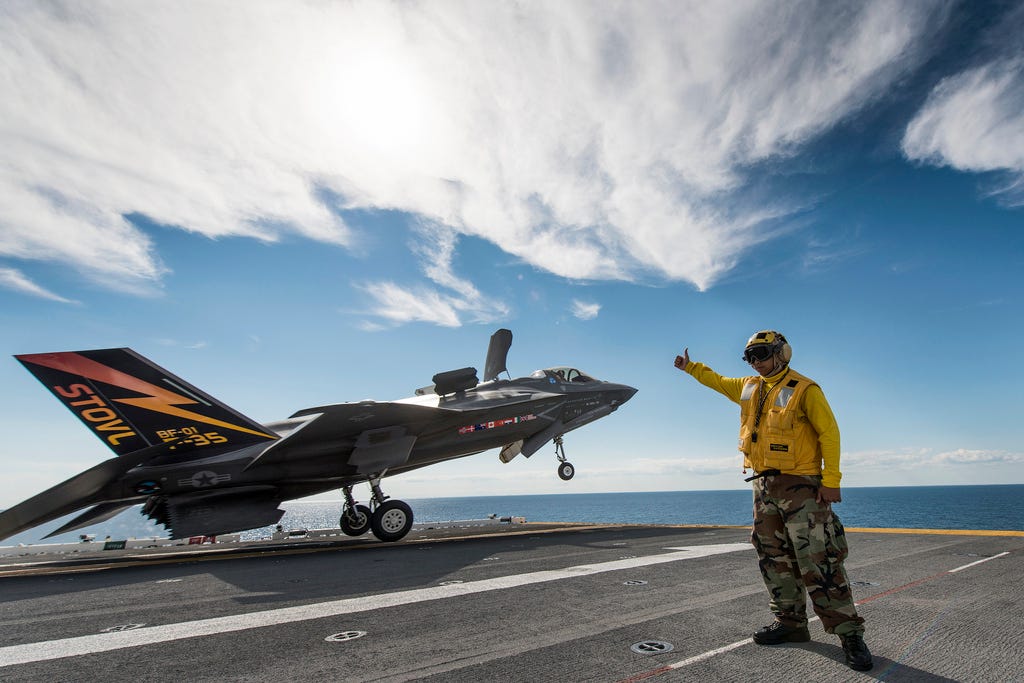
The Marine Corps plans to buy 340 of the F-35B, which can take off like a conventional fighter and land like a helicopter. While the ground testing is suspended, pilots can continue development and training flights on the 38 fighters already delivered, according to DellaVedova.
The Defense Department plans to request funds for nine Marine Corps planes in fiscal 2016 and 20 in 2019, according to internal budget figures. The short takeoff and vertical landing model is also being bought by the U.K. and Italian militaries.http://www.bloomberg.com/

Sunday, 16 February 2014

Su-35 does not guarantee air superiority for the PLA Air Force: PLA Daily

Major figures within the People's Liberation Army Air Force have differing opinions about whether purchasing Su-35s from Russia really serves the interests of the Chinese military aviation industry, according to the Taipei-based Central News Agency (CNA) in an interview with Andrei Chang, a Canadian military analyst.
During a press conference held at the Singapore Air Show of 2014, Mikhail Pogosyan, the general director of United Aircraft Corporation, said that Russia is unlikely to support China copying its advanced fighters again as it did in the 1990s. Copying other nation's fighter will not bring any major improvement to the Chinese aviation industry, especially since the Su-35 is not a new fighter. China should design its own advanced fighter, Pogosyan said.
The Su-35 does not guarantee air superiority for the PLA Air Force in the next 10 years, a professor from the PLA Air Force Command College said in a commentary for the Party-run PLA Daily. A similar view is being shared by many important figures in the Chinese military, said Pinkov. The current consensus reached between Beijing and Moscow will provide 24 Su-35s along with Saturn AL-41s — also known as 117S engines — to China.
Still, both sides have not reached any agreement yet regarding the transfer of Su-35's technology to China. Even though Russia is trying to terminate its cooperation with China in designing new fighter, Pogosyan said that it will be more suitable for both nations to help each other in building wide-body commercial aircraft.http://www.wantchinatimes.com/

Monday, 10 February 2014

İndonesia May Replace F-5s With Su-35s

Jakarta's Choice: Indonesia will replace its aging F-5 fighter aircraft, built by US company Northrop, with the latest Sukhoi Su-35s, similar to this Russian Air Force Su-35S, flying at the MAKS-2011 airshow in Russia.

Indonesia’s defense authority is leaning toward a plan to purchase 16 of the latest generation of Russian twin-engine Sukhoi Su-35 multirole fighters to replace its F-5 Tigers.

The decision to purchase the Russian fighters came after a meeting between Defense Minister Purnomo Yusgiantoro and Indonesian military top brass, including Military Commander Gen. Moeldoko and Air Force Chief of Staff Marshal Ida Bagus Putu Dunia in mid-January.


Speaking to reporters, Yusgiantoro said they also considered other options to replace the aging Tigers beyond the Su-35 purchase.Moeldoko said the Air Force will hold further evaluations of other fighters prior to making a final decision. Other fighters under evaluation are the Saab JAS 39 Gripen, Lockheed Martin F-16 Block 60, Boeing’s F-15 Silent Eagle and F/A-18 Super Hornet, and the Dassault Rafale.


An Air Force adviser — a retired three-star Air Force marshal — hinted that the American fighters would likely be preferable for Indonesia.


The adviser, however, said the Tiger replacement would not be decided in the near future, despite claims that Indonesia is ready to equip its Air Force with a squadron of new fighters.The Indonesian Air Force operates six F-5Es and two South Korean T-50 Golden Eagle advanced supersonic trainers.


The Air Force is also equipped with 10 F-16A/Bs and a squadron of Su-27/30s.During the first phase of the Indonesian Defense Strategic Plan, the Air Force has begun receiving 16 T-50s, with final delivery expected by the end of this year.


Debate has been rife in Indonesian defense circles over whether to buy Russian, European or US fighters. A final decision will be made after the presidential and legislative elections scheduled for October.http://www.defensenews.com/

Thunder Resonates as Modernization Inches Forward in Pakistan


Financial difficulties aside, Pakistan is modernizing its air power mainly through investing in the critical JF-17 Thunder program. But the Chengdu J-10B/FC-20 order is less certain.

With a funding crunch, the Pakistan Air Force “will concentrate most resources on JF-17 to ensure its success and further development,” said Usman Shabbir, with the Pakistan Military Consortium think tank.

Last year, the Air Force admitted modernization efforts under the Armed Forces Development Plan 2025 had gone unfunded since 2007. However, Pakistan secured a Chinese loan to keep JF-17 production on track. No details, including the amount of the loan, have been made public.


Production of the second block of 50 began in December. With 50 jets in service, Pakistan’s requirement is for up to 250 planes to replace its Mirage and F-7 aircraft. It already has replaced the A-5C Fantan strike fighter with two squadrons.

The Block II JF-17 has improved avionics, weapons load and carriage capability, a data link and an electronic warfare suite, plus an in-flight refueling capability, but officials are reluctant to give specific details.

A spokesperson for the Pakistan Aeronautical Complex (PAC), which jointly manufactures the JF-17 with China’s Chengdu Aircraft Industry Group, would say only that the avionics suite is a “mixed package” and has been contracted.

Shabbir said he believes the NRIET KLJ-7 X-band radar will have been retained for the Block I/II aircraft, and standoff weapons such as the Ra’ad air-launched cruise missile, H-2/H-4 glide bomb and Mectron MAR-1 anti-radiation missile might also have been integrated onto the Block II jets.

Multiple ejector racks will make up for a lack of additional weapon store stations, and a dedicated designator pod station could be added later underneath the plane’s port intake.

No JF-17 has been seen carrying a designator pod, but a Chinese type will likely enter service, even though Shabbir said the Pakistan Air Force’s Air Weapons Complex “has also developed one in collaboration with a European firm.”Which firm is unknown, but PAC collaborates with European companies such as Selex ES and Sagem.

Shabbir said the addition of a separate forward-looking infrared (FLIR) sensor is unlikely, and those fitted to Mirage 5s would not be “recycled” because “the FLIR-equipped [retrofit of strike element-III] Mirages will soldier on for many years as they are specialist night attack aircraft.”

Further avionics improvements will probably wait until Block III production begins in 2016, with an active electronically scanned array radar variant of the KLJ-7, he said. But “so far, Block III is just conceptual, and even though PAF/PAC and CATIC [China National Aero-Technology Import & Export Corp.] agree on broad terms what capabilities Block III should offer, the design is not finalized,” Shabbir said.

The importance to Pakistan aside, for CATIC, the FC-1/JF-17 is an export program that has yet to secure an order and become profitable. Production lines in both countries are underutilized. PAC produces 18 aircraft a year but has a capacity of 25.This has caused some friction, as the Pakistan Air Force wants to meet its requirements before concentrating on exports.

Douglas Barrie, a senior fellow for Military Aerospace at the International Institute for Strategic Studies, said he believes China could influence exports as “a Chinese purchase of the aircraft, even if only in token numbers, would also bolster its credentials.


“There’s no obvious reason why the Chengdu JF-17 should not be a credible contender in a number of markets where a more capable combat aircraft is either unaffordable or unavailable, particularly in some African and possibly Middle Eastern states looking to replace legacy types with a low-cost platform,” he said.Barrie highlighted the “reasonable selection of air-to-air and air-to-surface weapons,” and said the air-to-air SD-10/PL-12, a beyond-visual-range missile, is a “credible weapon.”

J-10 Purchases

A Pakistan Air Force purchase of the FC-20/J-10B, while attention focuses on JF-17 exports, would therefore be favorable, Shabbir said. However, the status of the deal is uncertain and there is thought to be a discussion within the Pakistan Air Force as to its fate.

The country’s Defence Ministry would not comment on the matter, and the Air Force has not responded to queries.Shabbir said the order “was always planned to be signed in the 2014-2015 time frame.” A reported US $1.4 billion agreement was negotiated for 36 FC-20/J-10B aircraft in 2009, with reports at the time claiming they would enter service around 2014 or 2015, but that date has slipped.

However, “if money becomes an issue and if the [Indian Air Force] does not go for the Rafale [fighter jet], it is possible that the [Pakistan Air Force] might drop the FC-20 plan and invest even more resources into the JF-17 project, along with buying more used F-16s and bringing them to Block 52 standard,” he said.

Former Air Force pilot and analyst Kaiser Tufail said, “Purely from a political standpoint, it would be wise for the [Air Force] to diversify its source of advanced fighters of the F-16C class. China is an obvious reliable source and the FC-20 is a possible candidate, though my personal assessment is that overall, it is not as advanced as the F-16C [Block 50/52].”Yet he still believes ordering the FC-20/J-10B could benefit the JF-17.

“I think that later JF-17 Blocks III and IV could possibly have avionics systems commonality with the FC-20, as these would have been tried and tested systems on the latter aircraft,” he said.

Though Tufail admitted the possibility of speculating too far, “since the specifications and airframe configuration of the later JF-17 Block III and IV is not at all clear, it would be futile to speculate if hardware other than avionics systems could find commonality with the FC-20,” he said.

Similarly, Tufail said he’s uncertain whether a Chinese stealth jet would be a better option than the FC-20/J-10B, as “the full performance capabilities of the Chinese stealth aircraft are not known as yet and on this account, it may be premature to draw up a wish list.”http://www.defensenews.com/

Sunday, 2 February 2014

Joint production to be norm in new Indo-Russian defence projects

A major highlight of Indo-Russian relations in 2014 is expected to be the fifth generation fighter aircraft, whose first prototype delivery has already been delayed by about two years and is now expected later this year.


the current focus in Indo-Russian bilateral relations is on consolidation and sticking to conventional diplomacy. This unwritten, unsaid policy is in place in all fields of Indo-Russian ties, particularly in the defence arena. Movers and shakers of India’s Russia policy believe that Indo-Russian relationship is too crucial to be allowed to go adrift, but the need of the hour is to deliver on current projects rather than keep on signing new defence deals.
Moreover, the Indian political system has already hit the pause button with general elections scheduled to be completed before May this year. The new government would take at least four to six weeks to settle down, meaning that nothing spectacular should be expected in Indo-Russian ties in the first half of this year.http://indrus.in/
A key Indian official responsible for navigating Indo-Russian relations said things are panning out well. An example of this was the BrahMos supervisory council that met in Moscow last week.
The official did not divulge details of what transpired at the meeting and refused to say whether the issue of export of BrahMos missiles to third countries was taken up. The official, however, said that all major points of differences between the two sides on the project were removed at last week’s meeting.
The official disclosed that many new defence deals would come up between India and Russia later this year but declined to give specific details. It is understood that outright purchases by India from Russia would be few and far between. Instead, the flavor of the season is to go for joint production.
A major highlight of Indo-Russian relations in 2014 is expected to be the fifth generation fighter aircraft (FGFA), whose first prototype delivery has already been delayed by about two years and is now expected later this year.
FGFA to be a major test case
India is keeping a very close watch on the progress of the FGFA project which has a potential of becoming the biggest and most expensive Indo-Russian defence project costing India $30 billion. However, New Delhi will loosen its purse strings only if its concerns about value for money, cost-overruns, delays and 40 to 45 improvements in the fighter aircraft’s design demanded are met by the Russians.
The next big thing on the FGFA project is signing the R&D phase of the project which is likely to cost $11 billion.
Much depends on how soon the first prototype is delivered to India and how it performs during trials in the Indian skies. In August 2012 the then chief of Indian Air Force (IAF) Air Chief Marshal NAK Browne had gone on record as commenting thus: “The first prototype of the FGFA is scheduled to arrive in India by 2014 after which it will undergo extensive trials at the Ojhar air base (Maharashtra)...we are hopeful that the aircraft would be ready for induction by 2022.”
India has already conveyed its unease to the Russians over the fact that it is getting only 15 percent of the research and development work share despite paying half the development cost. The Russians have promised to do the needful.
The second and third prototypes are to arrive in India in 2017 and 2019 respectively and the IAF has planned to induct the fighter by 2022, if all goes well.
The Indians are increasingly laying focus on self-reliance and not taking recourse to outright purchase of defence equipment from foreign sources unless it is absolutely critical to national security and such technology is not available in India. This policy is unlikely to be changed by the new government whichever party comes to power.

Thursday, 30 January 2014

Some Embarrassing Details From the Pentagon’s Latest Stealth Fighter Repor


The Pentagon’s latest weapons testing report is not kind to the $400-billion F-35 Joint Strike Fighter, the military’s biggest and arguably most troubled program. The annual report by the Office of the Director of Operational Test and Evaluation includes 20 pages listing the Lockheed Martin-built JSF’s ongoing problems.
A jack-of-all-trades radar-evading jet meant to replace no fewer than 2,400 existing fighters in the U.S. Air Force, Navy and Marine Corps, the F-35 has been dogged by budget overruns, schedule delays and redesigns. Overly complex in order to satisfy the diverse needs of three military branches, the F-35 is slower, less durable and less reliable than many of the planes it’s slated to replace.
Most damningly, the 2013 test report predicts months of delays in the development of the F-35’s millions of lines of software, which could cause the Marine Corps and Air Force to miss their planned first deployments of combat-ready JSFs in 2015 and 2016, respectively.
But the DOT&E report also includes lots of other embarrassing details.


An F-35B during at-sea testing aboard the USS ‘Wasp.’ Lockheed Martin photo

Only one third of F-35s are flight-ready

The military manages to keep around three quarters of its warplanes ready for flight at any given time. Even the Air Force’s devilishly complex F-22 stealth fighter—another Lockheed product—is ready 69 percent of the time.
But the roughly 50 F-35s in test or training squadrons in Florida, California, Nevada and Arizona are ready just a third of the time, on average. That’s because the jets need frequent design fixes and because Lockheed’s automated supply system isn’t working.
Now, it’s not uncommon for a new warplane to start out a tad unreliable and get more ready over time. But the F-35 has been flying in one form or another off and on for 14 years. “The design is becoming more stable and opportunities for reliability growth are decreasing,” the report notes.
“While the relatively low number of flight hours shows there is still time for program reliability to improve,” the report continues, “this is not likely to occur without a focused, aggressive and well-resourced effort.”
Which is to say, making the JSF more flight-ready is going to also make its development more expensive.


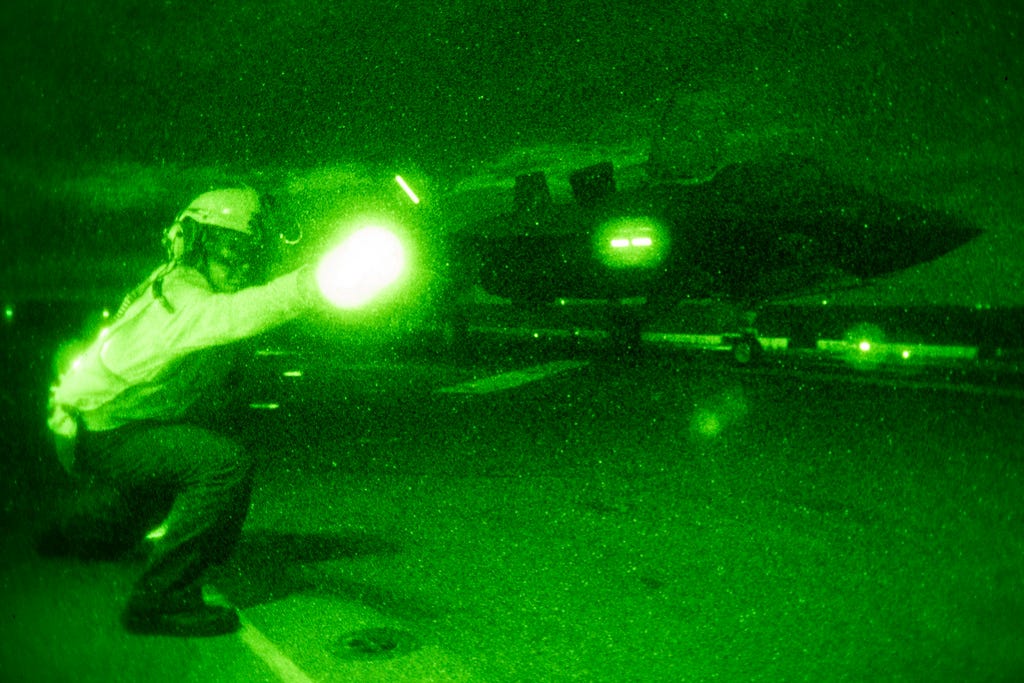
An F-35B during night testing aboard USS ‘Wasp.’ Lockheed Martin photo

The F-35 will get you lost

The JSF is designed to fly and fight against the most determined foe—even a foe capable of jamming or destroying America’s Global Positioning System satellites, depriving U.S. forces of their preferred way of knowing exactly where they are in the world.
But the F-35’s independent “inertial” navigation gear—which determines the plane’s position by constantly computing starting point, direction, speed and time—is off by a few degrees. That’s just enough to make it useless in combat. “These errors prevent accurate targeting solutions for weapons employment in a GPS-denied environment,” the Pentagon warns.
A software fix is in the works, but “further flight testing will be required.” Again, that takes time and money.


An F-35 drops a laser-guided bomb. Lockheed Martin photo

The JSF’s main air-to-air missile doesn’t fully work—and it’s not clear why

The F-35 needs three basic weapons in order to be cleared for combat in 2015: a laser-guided bomb, a satellite-guided bomb and the AIM-120 air-to-air missile.
The nav system problems slowed the addition of the satellite bomb—basically, the munition didn’t know where to land. That, at least, was a known unknown—and engineers were able to solve it with a “fix in the mission systems software,” according to the report.
But the AIM-120 isn’t working on the F-35, either. And in contrast to the bomb problem, testers have not been able to resolve the missile issue because they can’t quite duplicate it. “Problems involving integration of the AIM-120 medium-range missile have been difficult to replicate in lab and ground testing,” the report notes.
It is, in other words, an unknown unknown. And who can say what the solution is.


The F-35 confuses itself

To defend against increasingly sophisticated Russian- and Chinese-made air defenses, the JSF includes a cluster of high-tech cameras and sensors able to detect incoming missiles—and automatically deploy heat-generating flares or radar-foiling chaff to spoof the enemy guidance.
But the so-called “Distributed Aperture System” doesn’t work. “The DAS has displayed a high false alarm rate for missile detections during ownship and formation flare testing,” the testing report reveals. Basically, the system cannot tell the difference between an enemy missile and one of the F-35’s own hot flares.
Imagine the feedback loop that could result. An F-35’s DAS detects an incoming missile and pops flares. DAS then mistakes those flares for another missile and pops more flares, then still more flares to spoof them. So on and so on until the F-35 runs out of countermeasures … and is defenseless.


An F-35B in vertical mode. Lockheed Martin photo

It takes just one bullet fragment to shoot down an F-35B

The Marines’ F-35B variant includes a built-in vertical lift fan—basically, a downward-blasting engine—to allow the plane to take off of and land on the Navy’s small amphibious assault ships. But adding a bulky lift fan made the JSF heavier, more complex and easier to shoot down.
That’s especially true for F-35Bs flying low to support Marine infantry on the ground. A lone enemy soldier firing a single bullet could seriously damage an F-35B. “Analysis showed that fragment-induced damage could result in the release of more than 25 percent of a single lift fan blade, resulting in a catastrophic … system failure,” the DOT&E report warns.
And if the F-35B has to fly through high-tech air defenses in order to reach the beachhead, it’s even more likely to get shot down. “More severe threats, encountered at low altitude or in air-to-air gun engagements, will likely cause catastrophic damage.”
All this means that even if the JSF manages to meet its 2015 deployment deadline, it could fly into combat unreliable, confused, defenseless, toothless and vulnerable.https://medium.com

F-35 faces familiar dogfight with competing facts

More than 12 years after launching development, a now-familiar scenario for the Lockheed Martin F-35 programme is playing out again: a team of outside government evaluators predict a major new delay for entry into operational service, while programme insiders insist that no such thing will happen.
Only time will tell which side’s predictions prove most accurate, but the history of the F-35's thrice-delayed operational debut favours the Federal team.
The latest debate focuses on the newly-released annual assessment by the office of Michael Gilmore, director of the office of test and evaluation (DOT&E).
Last July, Gilmore told Congress that he expects the Block 2B software required for the US Marine Corps to declare the F-35B operational will be delivered eight months late. His latest assessment extends the delay by another four months until July 2016: one full year behind the USMC’s schedule.
asset image
The Marine Corps, however, says the programme remains on track to declare initial operational capability with the short take-off and vertical landing (STOVL) variant of the F-35 in July 2015. The US Air Force and US Navy have decided to wait at least another year for the Block 3F software release before declaring IOC.
Lockheed, meanwhile, criticises the DOT&E’s assessment of a one-year delay as being based on an inflated test point growth rate.
Block 2B development testing experienced a 120% increase in test point growth in 2013, and the DOT&E assumed the same rate will be required this year. Lockheed, however, points out that 41% of the test point growth was blamed on re-testing fixes for the F-35’s glitch-prone helmet-mounted display system. Curiously, the DOT&E report claims that the helmet caused only 22% of the extra test points in 2013. The document also points out that the one-year delay prediction is based on a growth rate that excludes re-testing activity for the helmet-mounted display.
asset image

Getting the F-35’s impressive helmet to work, however, remains a problem, according to the report. The F-35 test team dedicated 42 flights to investigating and addressing problems with the system – and the bugs are not new. The joint programme office threatened last year to switch suppliers, but ultimately decided to stick with Vision Systems International, a joint venture between Elbit Systems andRockwell Collins.
Some problems will require the F-35’s long-unrequited customers to spend more money to fix them. The DOT&E report concludes that night vision acuity on the helmet display will only improve if the programme decides to upgrade to a third-generation version of the same helmet, which features a better night vision camera.
But the F-35’s development problems have always been broader than any single system. Software to manage the F-35’s flight controls and mission systems has been a particular issue.
While the USMC waits for the Block 2B software, Lockheed is running months behind schedule on the preceding Block 2A package. Despite being installed on dozens of aircraft procured in the programme's fourth and fifth lots of low-rate initial production, Lockheed delivered the Block 2A software with nearly half of the contractually required software functions incomplete, the report says. Even as Lockheed continued working on Block 2A, the company handed over the initial increment of Block 2B software on time last February.
A second increment of Block 2B software arrived in October 2013, but the initial results did not seem encouraging. The software still has function problems with fusing sensor information and operating the F-35’s many sensors – including its APG-81 radar, ASQ-236 Barracuda electronic warfare systems, electro-optic targeting system and the distributed aperture system.
Three more increments of the Block 2B software will be released this year, with each one expected to gradually improve the maturity of the software and fix the bugs.
More promising has been the pace of testing intended to clear the F-35's flight envelope. The DOT&E report shows that all three variants remained generally on track in 2013 despite a variety of distractions, ranging from a weeks-long government shutdown and temporary fleet-wide groundings caused by component failures on the F-35A and F-35B.
Although the teams are making progress, the F-35’s engineers are still struggling with overcoming the aircraft’s tendency for transonic roll-off and buffet, according to the report. The condition affects all supersonic fighters to some degree, but has appeared particularly acute on the carrier variant F-35C. Programme engineers have exhausted options for altering the flight control laws to compensate. Testing is still under way to decide if using leading edge spoilers on the F-35C will be necessary, the report says.By: STEPHEN TRIMBLE http://www.flightglobal.com/

Monday, 27 January 2014

F-16 Upgrade Dropped From US Budget Proposal, Sources Say

F-16's Taxi and Take Off

— A major F-16 upgrade program is likely to be left out of the president’s fiscal 2015 budget request, according to multiple sources.The Combat Avionics Programmed Extension Suite (CAPES) is a US Air Force program to replace the avionics and radars for 300 US F-16s. It would also upgrade 146 Taiwanese F-16A/B fighters purchased in the 1990s.

Sources said the US Air Force has decided not to fund the CAPES program, instead reinvesting some of that money toward a general F-16 service-life extension program (SLEP) while putting the rest toward modernization efforts for other platforms.While costs for the CAPES program are unclear, both Pentagon insiders and outside analysts put the figure in the billions.

The core of CAPES is a new active electronically scanned array radar. In 2013, Lockheed Martin, the prime contractor on CAPES, selected Northrop Grumman’s Scalable Agile Beam Radar to be installed in the planes. Northrop beat competitor Raytheon, which had put forth its Raytheon Advanced Combat Radar as an alternative.

In addition to the radar, CAPES would include a new high-resolution, color, multi-function display, an electronic warfare suite and an integrated broadcast service for multiple intelligence broadcasts, according to a government report.By moving money toward the SLEP, the Air Force would provide some cover against the F-35 joint strike fighter slipping past its December 2016 initial operating capability date. It is also possible that some of the advanced avionics could become part of the SLEP, offering a cheaper, halfway method toward modernizing the F-16s.

“There is a real force structure problem looming. So something has to be done to keep the F-16, or at least part of the F-16 fleet, effective,” said Richard Aboulafia, vice president of analysis with the Virginia-based Teal Group.The Air Force appears to be planning “the bare minimum, rather than something that would offer more capability,” he added. “That helps solve the force structure problem, but of course it doesn’t do anything for combat effectiveness.”

Aboulafia also noted that this could have ramifications on the international radar market. The Raytheon radar was selected by South Korea early last year, and Singapore remains in play, as well;if Northrop loses CAPES it could harm long-term prospects for other radar upgrade programs.Northrop would appear to be the big loser if CAPES is defunded, and could activate its network of supporters in Congress to fight the cut. However, the Air National Guard would stand to benefit from a more robust SLEP, giving the move some support on the Hill.

A Northrop spokeswoman declined to comment on budget speculation, while a Lockheed spokesman did not immediately provide a statement. Per service policy, an Air Force spokeswoman declined to comment on budget details prior to its submission to Congress.While losing out on CAPES would be a blow to the Pentagon’s fleet of F-16s, it would have much greater impact on Taiwan.

In 2011, the US Air Force awarded Taiwan a $5.3 billion upgrade program for its remaining fleet of 146 F-16A/B fighters. Taiwan’s program would be directly based on the CAPES program, with USAF making all of the source selections.

The one complaint Taiwan’s Ministry of National Defense (MND) had with the deal was that Taiwan was being saddled with much of the nonrecurring engineering costs for integrating the radar.Taiwan officials were confident, however, that riding CAPES’ coattails would prove wise. Officials were also anxious to please the Pentagon.


With CAPES defunded, MND officials are expected to “panic,” said Fu Mei, director of the Taiwan Security Analysis Center.“This is a crisis,” he said. “Taiwan should have taken more control over the source selection instead of handing it over to the [US Air Force] to run it.”

“Now Taiwan’s MND will have to figure out an exit strategy even though the warning signs were there,” he said. “The MND did not begin exploring their contingency options soon enough even though warned by industry analysts.”

Without CAPES funding, Taiwan might not be able to afford the F-16 upgrade program. Last week, the MND announced a 20 percent cut in the size of the military over the next five years. Taiwan is struggling due to a decline in the economy and difficulty paying off $13 billion worth of military equipment procured from Washington since 2008.

The president’s budget is expected to be unveiled March 4. Sources have also told Defense News that Northrop’s Global Hawk unmanned system will be funded in the budget, despite the service repeatedly trying to kill the unmanned system. ■y AARON MEHTA & WENDELL MINNICK http://www.defensenews.com/

Sunday, 26 January 2014

Russia To Order MiG-29SMT Fighter Jets

(FILES) A fighter jet type Mikojan MIG-2

WARSAW — Russia’s Ministry of Defense is aiming to order 16 Mikoyan MiG-29SMT jet fighters for the Russian Air Force, said Deputy Defense Minister Yuri Borisov. The ministry is expecting to ink the contract in the first quarter of this year, Borisov told local news agency RIA Novosti.
Meanwhile, the Russian military is also awaiting the delivery of Su-35 jet fighters, expected to begin in early 2014, according to the deputy defense minister. In January, the aircraft completed its test flights.

“Only five years ago, the Ministry of Defense was buying one or two fighters per year, and in 2014 [it will acquire] 100 aircraft and more than 100 helicopters,” Borisov said.

The MiG-29SMT, which entered serial production in 2004, is manufactured by Moscow-based Russian Aircraft Corporation MiG. The jet fighter is fitted with a glass cockpit and a Zhuk-ME radar, which allows it to track up to 10 air targets and fire missiles at four targets simultaneously. The aircraft has a top speed of 2,400 kilometers per hour at high altitudes, according to data released by the manufacturer. ■http://www.defensenews.com/

Saturday, 25 January 2014

Shenyang J-16 undergoing flight test

J-16

Chinese social media revealed yet another new fighter aircraft development programme currently undergoing flight test. The latest revelation is a Shenyang (SAC)-produced copycat of the Russian Sukhoi Su-30MKK (NATO code name: Flanker-G) two-seater multirole fighter, reportedly designated by the PLAAF as the J-16.
It is now a common knowledge that China has been reverse-engineering the Sukhoi Flanker series fighter aircraft using examples it purchased from Russia in the 1990s. After a short-lived co-production of the basic variant Su-27SK (Flanker-B) known as J-11 between 1998 and 2002, Shenyang Aircraft Corporation (SAC) began to produce an indigenised version known as J-11B in 2004. This was followed by a two-seater variant J-11BS (Su-27UBK Flanker-C) in 2007. In 2009, Shenyang successfully flew the J-15 carrier-based fighter, which was developed by modelling the T-10K, the prototype of the Russian Navy Su-33 (Flanker-D). In recent years, Russia has repeatedly expressed its concerns over the unlicensed copying of Russian fighters by Chinese manufacturer, a key factor that hindered the recent negotiation on the Su-35 (Flanker-E) deal with China. However, this did not seem to have stopped China producing even more Sukhoi-copies, with the J-16 being the latest example.
The Su-30MKK is the first true ‘multirole’ fighter in the Sukhoi Flanker family. China has acquired a total of 100 examples from Russian between 2001 and 2004, including 24 examples in the improved MKK2 variant for its Naval Air Force. The aircraft is equipped with sophisticated electronic countermeasure (ECM) and C4ISR suite for target acquisition and weapon guidance, and is capable of delivering a wide range of air-to-air and air-to-surface weapons. The J-16 is likely going to be equipped with Chinese-made weapon suite, possibly including the PL-12 ‘beyond-visual-range’ MRAAM, the YJ-91 (Kh-31P copy) anti-radiation missile, the YJ-12 supersonic anti-ship missile, the KD-88 TV-/radar-guided air-to-surface missile, and various laser-guided bombs.
The Su-30MKK/J-16 has a combat radius of 1,600 km without requiring aerial refuelling. This is increased to 2,600 km with one refuelling, or 3,500 km with two. This allows the aircraft to reach targets as far as the Java Sea even taking off from inland airfields, or loiter for significant periods over contested areas of the South China Sea. Another distinctive advantage of the aircraft is its sophisticated C4ISR capability, which allows the aircraft to either operate alone, or as an airborne command post for other combat aircraft (as how the Su-30 was originally proposed for the Soviet Air Force).
The J-16 is only one latest example of the booming Chinese military aviation industry, which is running at least five or six fighter aircraft development programmes in both 4thand 5th generation simultaneously. In a world where military budgets are being cut left right and centre everywhere else, development at such a scale is truly unparalleled. However, a closer examination of these programmes suggests that most of these programmes merely to allow the PLA to catch up with its counterparts in Russia and Western world, since similar aircraft have already been in service with these air forces for a decade or more (for example, the Boeing F-15E, widely regarded as a close comparison to the Su-30MKK/J-16, entered service with the USAF in 1988). Nonetheless, the latest developments will no doubt put the PLAAF in the league of the world’s best equipped air forces.http://sinodefence.com/