Showing posts with label United Kingdom. Show all posts

Wednesday, 26 February 2014

Mystery Stealth aircraft spotted in UK. A cancelled Black Project being revived?


The aircraft being moved is probably a full size model of the BAE Replica, a British stealth aircraft model developed by BAE in the 1990s and used for radar testing before its associated program, the FOAS (Future Offensive Air System), was cancelled in 2005.
The FOAS was a study aimed at finding a replacement for the RAF Tornado GR4. After the program was scrapped, it was replaced by the Deep and Persistent Offensive Capability (DPOC) program that was itself cancelled in 2010, following the UK military’s spending review.
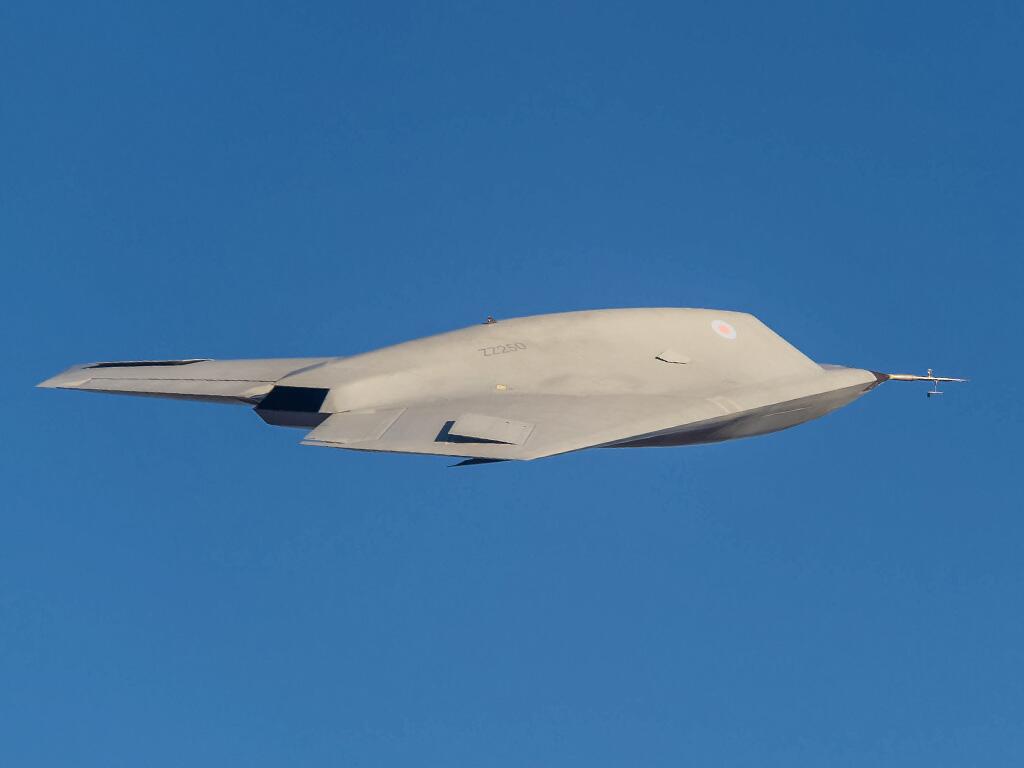
The Taranis UCAV (Unmanned Combat Air Vehicle) a semi-autonomous pilotless system that will feature an intercontinental range and will be able to carry a wide variety of weapons, including PGMs (Precision Guided Munitions) and air-to-air missiles, emerged as the eventual successor of the FOAS.
Anyway, the experience done by the BAE with the full-scale model of the BAE Replica is believed to be useful for the F-35, that is going to be the actual replacement for the Tornado GR4.
What’s unclear is what the airplane was doing in the open (and upside down). For sure nothing really secret (otherwise it would have been covered).
It’s been used for some additional tests on stealth technologies/designs? Something useful for the Taranis project or something else?http://theaviationist.com/

Monday, 24 February 2014

UK receives full complement of Reaper UAVs


The United Kingdom (UK) has received into service its final five General Atomics Aeronautical Systems Inc MQ-9 Reaper unmanned aerial vehicles, and will be transporting them into theatre "in the near future", a Ministry of Defence (MoD) spokesperson told IHS Jane's on 21 February.

The delivery brings to 10 the number of Reapers fielded in Afghanistan by the UK Royal Air Force (RAF), with the type expected to remain in-country as an intelligence, surveillance and reconnaissance (ISR) platform following the cessation of combat operations at the end of 2014.

These final Reapers were ordered in 2010 and were due to have been handed over in 2013. However, delays in clearing engineering modifications to the aircraft set this back by several months. The MoD declined to comment on the nature of these modifications.

The RAF has flown five Reapers out of Kandahar Airfield in southern Afghanistan since 2007. Initially operated by 39 Squadron out of Creech Air Force Base in Nevada, these platforms are now also controlled out of RAF Waddington in Lincolnshire by 39 Squadron and the newly re-constituted 13 Squadron.

In December 2013 the MoD released its latest weapon-release statistics for the Reaper. In the six years' of operations, the RAF's Reaper force had flown 54,000 hours, and had dropped or launched 459 precision weapons. While the MoD did not break down the figure in terms of the number of AGM-114 Hellfire air-to-surface missiles fired or Paveway laser-guided bombs dropped, Armed Forces Minister, Andrew Robathan, disclosed in 2012 that six Hellfires had been fired for every Paveway dropped to that date.

Despite being unmanned, the UK's Reapers are governed by the same rules of engagement as those applied to manned combat aircraft.http://www.janes.com/

Thursday, 20 February 2014

France negotiates acquisition of Watchkeeper drones against purchase of VBCI armoured by UK.

According to the French Ministry of Defense, the French Army could buy British-made Thales tactical UAVs Unmanned Aerial Vehicle Watchkeeper depending of the purchase of Nexter VBCI 8x8 armoured infantry fighting vehicles by the British government.

According to the French Ministry of Defense, the French Army could buy British-made Thales tactical UAVs Unmanned Aerial Vehicle Watchkeeper depending of the purchase of Nexter VBCI 8x8 armoured infantry fighting vehicles by the British governmen

The final text of the Declaration on Security and Defence signed at the UK-France Summit in January 2014 has now been released and it reveals some details about future European drone projects.

London and Paris will equally fund a total £120 million, two-year common feasibility study for the combat drone, dubbed the Future Air Combat System, the French MoD said in a statement.

The two countries agreed to investigate the possibility of working together on an advanced combat drone, with France agreeing to evaluate the Anglo-Israeli Watchkeeper drone. France is considering ordering since several years, the Watchkeeper drone which is in service with the British Armed Forces.

The acquisition of same UAVs by the two European countries facilitates international military operations and can reduce production costs and support.

Laurent Collet- Billon of the French Army procurement agency (DGA) said during a press conference, that the purchase of British Watchkeper UAV by the French army is related to the decision by the Britsih government to acquire the VBCI 8x8 armoured infantry fighting vehicle, designed and manufactured by the French Company Nexter Systems.

On cooperation in Europe, France has sent a combat vehicle, Véhicule Blindé Combat d’Infanterie (VBCI), to the UK, while the French Army is testing the Watchkeeper tactical UAV from the British Army. 


The VBCI is the latet generation of 8x8 armoured infantry fighting vehicle in service with the French army. It is in service with the French Army since 2008.

VBCI now constitutes the spearhead of the French Army’s infantry capability and Rapid Reaction Force. As such it has already been deployed in a wide variety of missions abroad from peacekeeping (Lebanon) to counter-insurgency (Afghanistan) or more conventional combat operations (Mali), further demonstrating its inbuilt operational versatility.

VBCI's major advantages is its protection, an essential requirement for modern armed forces, and highlighted by the experience acquired in the latest NATO led operations. Having been designed to be capable of participating alongside Main Battle Tanks in high-intensity combat operations, VBCI’s levels of protection outclasses that of existing armoured vehicles.


Watchkeeper WK450 is an unmanned aerial vehicle (UAV) for all weather, Intelligence, Surveillance, Target Acquisition and Reconnaissance use by the British Army. The Watchkeeper WK450 is based on the Elbit Hermes 450 UAV. The engine is a rotary Wankel engine. It has a mass of 450 kg and a payload capacity of 150 kg, with a typical endurance of 17 hours.

An agreement for the MBDA helicopter-borne missile, dubbed Anti-Navire Léger/Future Air-to-Surface Guided Weapon (Heavy), is a step toward British and French interdependence, based on a specialization of industrial skills, a second French official said.
The €500 million missile program is equally shared between the partner nations. Paris hopes the consolidation move will send a signal to other governments as European defense budgets erode, the official said.http://www.armyrecognition.com/

Wednesday, 5 February 2014

FIRST FLIGHTS OF UK-BUILT TARANIS UNMANNED AIRCRAFT SURPASS ALL EXPECTATIONS

Maiden flight
Taranis, named after the Celtic god of thunder, made its maiden flight at an undisclosed test range on Saturday 10 August 2013, under the command of our test pilot Bob Fraser.  The demonstrator aircraft made a perfect take-off, rotation, ‘climb-out’ and landing on its 15 minute first flight.  A number of flights took place last year, of up to one hour in duration and at a variety of altitudes and speeds.  The details were revealed at a briefing held in London today.
Under the control of a human operator
The Taranis demonstrator is the result of one-and-a-half-million man hours of work by the UK’s leading scientists, aerodynamicists and systems engineers from 250 UK companies.
The aircraft has been designed to demonstrate the UK’s ability to create an unmanned air system which, under the control of a human operator, is capable of undertaking sustained surveillance, marking targets, gathering intelligence, deterring adversaries and carrying out strikes in hostile territory.
Technological advances
The findings from the aircraft’s flight prove that the UK has developed a significant lead in understanding unmanned aircraft which could strike with precision over a long range whilst remaining undetected. The technological advances made through Taranis will also help the UKMOD and Royal Air Force make decisions on the future mix of manned and unmanned fast jet aircraft and how they will operate together in a safe and effective manner for the UK’s defences.
Jointly funded
Costing £185 million and funded jointly by the UK MOD and UK industry, the Taranis demonstrator aircraft was formally unveiled in July 2010 but only a very limited number of scientists and engineers have ever been given full access to the top secret aircraft.
Progress to date
Initial ‘power-up’ or ground testing commenced later in 2010 at our military aircraft factory in Warton, Lancashire followed by a comprehensive and highly detailed programme of pre-first flight milestones including unmanned pilot training, radar cross section measurements, ground station system integration and, in April 2013 taxi trials on the runway at Warton.
The aircraft and its ground station were then shipped from Warton to the test-range before being re-assembled and undergoing systems and diagnostics checks. Taranis then made a number of high speed taxi tests in July before its maiden flight in August 2013.
Major landmark for aviation
Philip Dunne, Minister for Defence Equipment, Support and Technology said:
"Taranis is providing vital insights that will help shape future capabilities for our Armed Forces in coming decades. Its advanced technology is testament to the UKs world leading engineering skills that keep Britain at the cutting edge of defence."
Commenting on behalf of the industry team, Nigel Whitehead, Group Managing Director, BAE Systems added: “The first flight of Taranis represents a major landmark for UK aviation. The demonstrator is the most advanced air system ever conceived, designed and built in the UK. It truly represents an evolution of everything that has come before it. This milestone confirms the UK's leading position as a centre for engineering excellence and innovation.”
Team Taranis
About the size of our Hawk Advanced Jet Trainer aircraft – we have designed and built Taranis working alongside Rolls-Royce, the Systems division of GE Aviation (formerly Smiths Aerospace) and QinetiQ working alongside UK MOD military staff and scientists. In addition to prime contracting the project, we led on many elements of the Taranis technology demonstrator, including the low observability, systems integration, control infrastructure and full autonomy elements (in partnership with QinetiQ).http://www.baesystems.com/

Thursday, 30 January 2014

Uparmored Bradley Could Be Tough Enough For AMPV: Testers

An Army M2 Bradley Infantry Fighting Vehicle in Iraq.
Massive government documents typically hide some gold nuggets of information. Intoday’s report from the Pentagon’s independent Director of Operational Test & Evaluation, a famously tough grader known as DOT&E, there’s one detail that is going to make defense contractor BAE Systems very happy:
“Results from the third underbody blast test also demonstrate that the Armored Multi-purpose Vehicle survivability requirement is achievable with a Bradley-like platform.”
Why should BAE care? Well, because BAE builds the M2 Bradley, a tank-like troop carrier, and because they’re entering a Bradley variant in the Armored Multi-Purpose Vehicle competition. With the much heavier, more powerful, and more expensive Ground Combat Vehicle (GCV) apparently in programmatic limbo due to budget cuts, the humble AMPV is the biggest game left in town for anybody who builds armored vehicles for the US military. That boils down to BAE and its competitor General Dynamics, which is offering a variant of its Stryker vehicle.
Why should anybody else care? The answer has to do with the deadliest single threat to US troops today, the improvised explosive device (aka the IED or just plan “roadside bomb”), and with how the Army can address that threat.
The Bradley looks like a tank — tracks, turret, gun, the works — but it is technically an “infantry fighting vehicle” because it carries half-a-dozen passengers into combat in addition to its three-man crew. The Bradley has been the Army’s frontline troop carrier since the 1980s, but like every other vehicle, it struggled to catch up to the ever-escalating IED threat in Iraq. While the uparmored Humvee and its replacement, the MRAP (Mine Resistant Ambush Protected truck), are the most famous cases, all sorts of other vehicles got extra armor, including the Bradley.
But even that wasn’t always enough. At the height of the surge, when sophisticated Iranian-designed IEDs called “explosively formed projectiles” were punching slugs of molten copper through American armor plate, one young officer told me he had to keep his Bradleys in the back of the column and lead with massive M1 Abrams tanks, because the Bradleys were just too vulnerable.
The Bradley undergoing the “underbody blast test” that DOT&E mentions, however, was partially upgraded to a new standard called “Engineering Change Proposal 1.” ECP1 doesn’t just add extra armor on the outside: It also changes the passenger compartment, especially the flow, and rearranges how ammunition is stored to minimize potential damage to the troops inside.
“The blast test revealed that significant improvements to the Bradley Fighting Vehicle Systems (BFVS) level of force protection and vulnerability are feasible,” DOT&E said. That’s good news for BAE, which wants to keep getting contracts to upgrade the Bradley, and it’s good for the Army, which isn’t going to replace its Bradleys any time soon now that the Ground Combat Vehicle is being put on hold.
Instead of buying Ground Combat Vehicles to replace Bradleys, the Army is now focused on buying Armored Multi-Purpose Vehicles to replace M113s, a lightweight tracked vehicle whose design predates the Vietnam War and which is considered so vulnerable the Army didn’t let them off its bases in Iraq. Back in the 1980s, the Bradley replaced the M113 in the mission of carrying infantry soldiers into combat, but the Army still has thousands of M113 variants serving support roles from armored ambulances to mobile command posts. Those vehicles aren’t just old: In the IED era, when enemies can attack your support forces more easily than your frontline troops, they’re also dangerously vulnerable.
The Army’s aspiration — more a hope than a plan given the current budget crunch — is to buy almost 3,000 AMPVs for $6 billion. BAE has to convince the Army that the Bradley design can be made survivable to have a shot at that contract.
The DOT&E report has some good news for BAE’s rival General Dynamics Land Systems, as well. GDLS builds the Stryker, a eight-wheel-drive armored transport. The Stryker troop carrier’s troubled brother is the Mobile Gun System, a Stryker variant fitted with an almost comically overlarge 105 millimeter gun, the kind of weapon normally reserved for battle tanks twice its size:
A Stryker Mobile Gun System (MGS) fires its 105 mm main gun.
After years of development problems, the Army ultimately bought 142 Mobile Gun Systems and sent MGS to war. As late as 2008, however, the Pentagon issued a report going through the MGS’s flaws. But it’s got better: “The Army has mitigated, by either material fixes or tactics, techniques, and procedures, 22 of 23 deficiencies identified in the 2008 Secretary of Defense report to Congress,” DO&TE wrote. What’s more, “in live fire testing,” an upgraded set of “Stryker Reactive Armor Tiles” (SRAT II) showed it could make MGS and a wide range of other Stryker subtypes more survivable without the expense of totally rebuilding the hull.
That gives the Army a cheaper option to upgrade older Strykers that to rebuild them entirely as “double-V-hull” vehicles. It also makes the MGS a more attractive option for the Army’s light infantry units, which are looking for a new light tank to support foot troops and even be flown in quickly to reinforce paratroopers.
By contrast, the lightest and most nimble part of the military, the Special Operations Forces, got some bad news in DOT&E’s report. SOF wants its own souped-up version of the most mobile type of MRAP truck, the M-ATV (MRAP All Terrain Vehicle), but it’s had problems and recent tests show that ” the most significant deficiencies were not resolved.” While the special ops M-ATV is nimbler and quieter than the standard version, DOT&E says, it’s too hard for the commandoes inside to see out in all directions: The rear windows are too small and the video camera on the remote-controlled rooftop weapon, called CROWS, has too limited a field of view. And if there’s one thing stealthy special operators hate, it’s for someone else to sneak up on them. http://breakingdefense.com/

Friday, 24 January 2014

British Army wants AH-64E Apache before end of decade


The British Army Air Corps (AAC) expects to replace its current AgustaWestland-Boeing WAH-64D Apache Longbow AH.1 attack helicopter fleet with the latest-variant AH-64E (formerly AH-64D Block III) "by the end of the decade", a senior service official disclosed on 23 January.

Speaking at the IQPC International Military Helicopter conference in London, the deputy commander of the tri-service Joint Helicopter Command (JHC), Brigadier Neil Sexton, said that, with the AAC's Apache AH.1 helicopters (Block I standard) suffering from obsolescence issues, the army "rather hopes" that the Boeing AH-64E Apache Guardian will be chosen as its successor, for fielding before 2020.

"The army is absolutely sold on [the Apache's] performance in Afghanistan," Brig Sexton said, adding: "[The Apache AH.1] has an extremely high profile with the public, mainly down to Captain Wales [Prince Harry] in Afghanistan."

As well the proven performance of the AH.1-variant Apache now in service, Brig Sexton noted that the enhanced capabilities of the AH-64E are proving to be highly alluring to the United Kingdom, especially with regard to manned-unmanned teaming. "We are watching very closely what the US is doing with this," he said, adding: "There is a lot of future potential for this with [the British Army's] Watchkeeper unmanned aerial vehicle."

In terms of numbers, Brig Sexton said that he does not expect any AH-64Es to be procured as one-for-one replacements for the Apaches currently in service (67 were purchased, with one lost on operations in Afghanistan), adding "but we don't need that". The most likely scenario will see the most costly systems on the current AH.1 aircraft - the M-TADS (targeting system), the fire control system, and the engines - being refitted into newly built airframes, with the equipment left over providing a ready-made pool of spares.

According to the brigadier, the Ministry of Defence (MoD) expects the acquisition process for the AH-64E to be decided "in the next couple of years", with a contract being signed shortly after. He could not say though whether this process would begin before the next UK general election in 2015. While Brig Sexton said that any procurement decision must be made with the US Army production run in mind, Boeing officials previously told IHS Jane's that programme delays incurred by sequestration were having the unintended consequence of buying the United Kingdom time in making its decision.


"With the US Army staring down the tunnel of sequestration, the new-build of 56 [AH-64E] helicopters has been delayed [634 AH-64Ds will also be remanufactured to AH-64E standard, of which 43 have been done to date]," said David Koopersmith, Vice President Attack Helicopter Programme for Boeing. "The [US Army] production line will not now start until about 2019/2020 and will run through until at least 2026, giving the UK the luxury of some flexibility," Koopersmith said at the Seoul International Aerospace and Defence Exhibition (ADEX) in October 2013.

The MoD is currently undertaking a capability sustainment programme (CSP) to sustain the UK's attack helicopter capability out to 2040 and beyond, but has declined to say when it will report the findings of this study. The AH-64E is understood to be one of a number of options being considered, with others being the procurement of a new helicopter type altogether or even the scrapping of the capability.http://www.janes.com/Gareth Jennings, London